Set Craft Atelier · Navdurga Spatial Design Exploration · 03 / 09
The bell rings. The waves expand. Courage awakens.
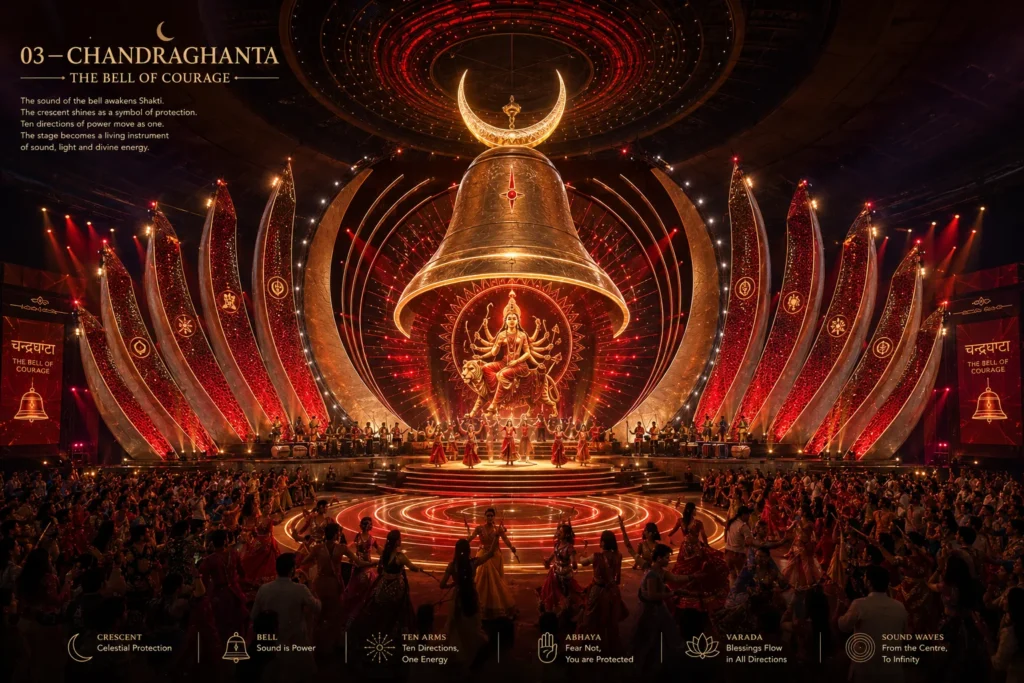
For the third world of our Navdurga design exploration, we looked at Chandraghanta not as a decorative theme for a stage, but as a starting point for its architecture and behaviour. How could a sacred bell become a live instrument of performance? How could a crescent become an architectural form? And how could the energy of a Garba audience be made visible through light and motion?
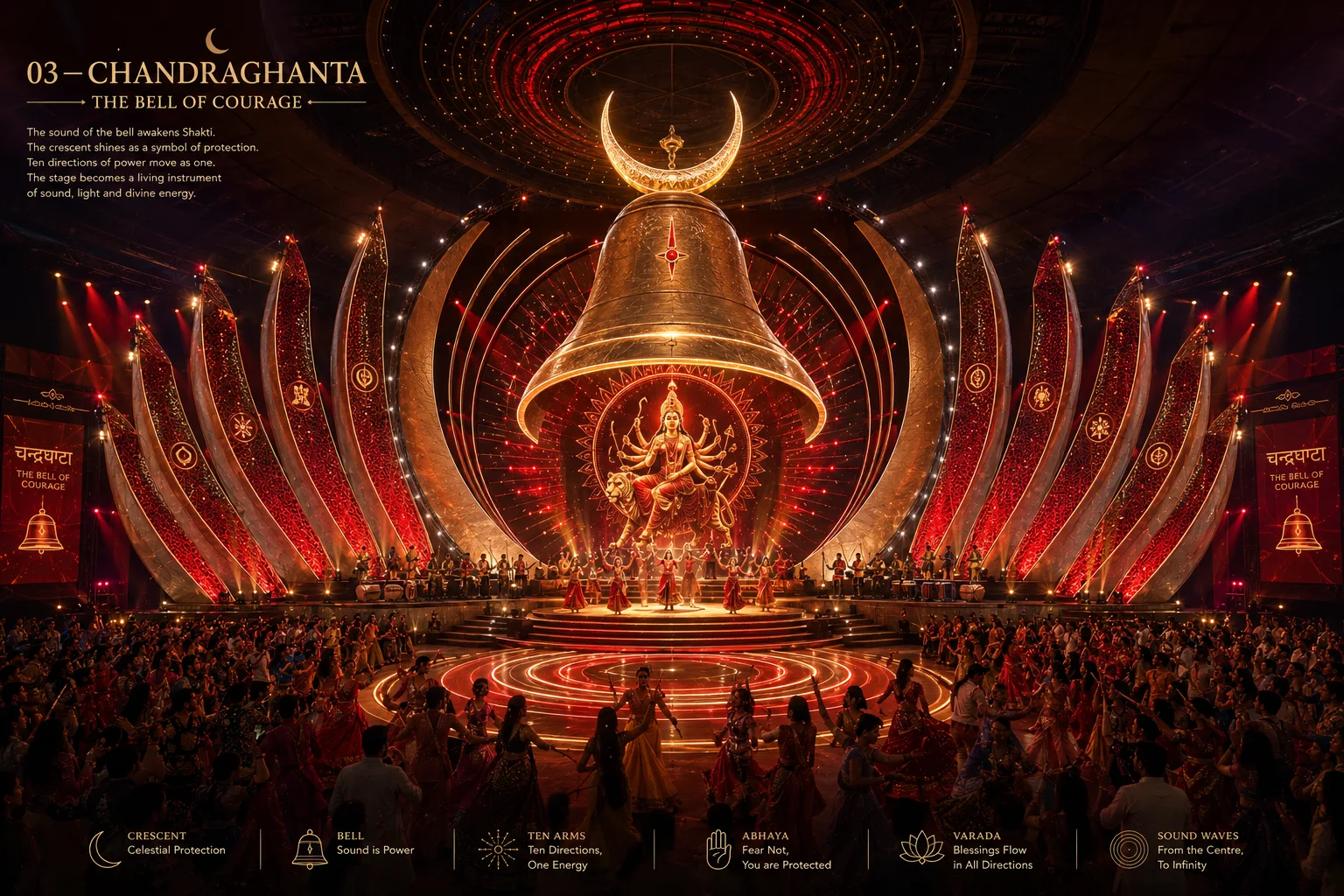
The proposed world translates the associations of courage, protection and awakening into a circular experience of sound, movement and collective energy. A monumental bell anchors the centre. A crescent-derived spatial structure frames it. Ten illuminated fins extend behind the performance space, while concentric luminous waves connect the stage to the audience.
01 — The bell as living architecture
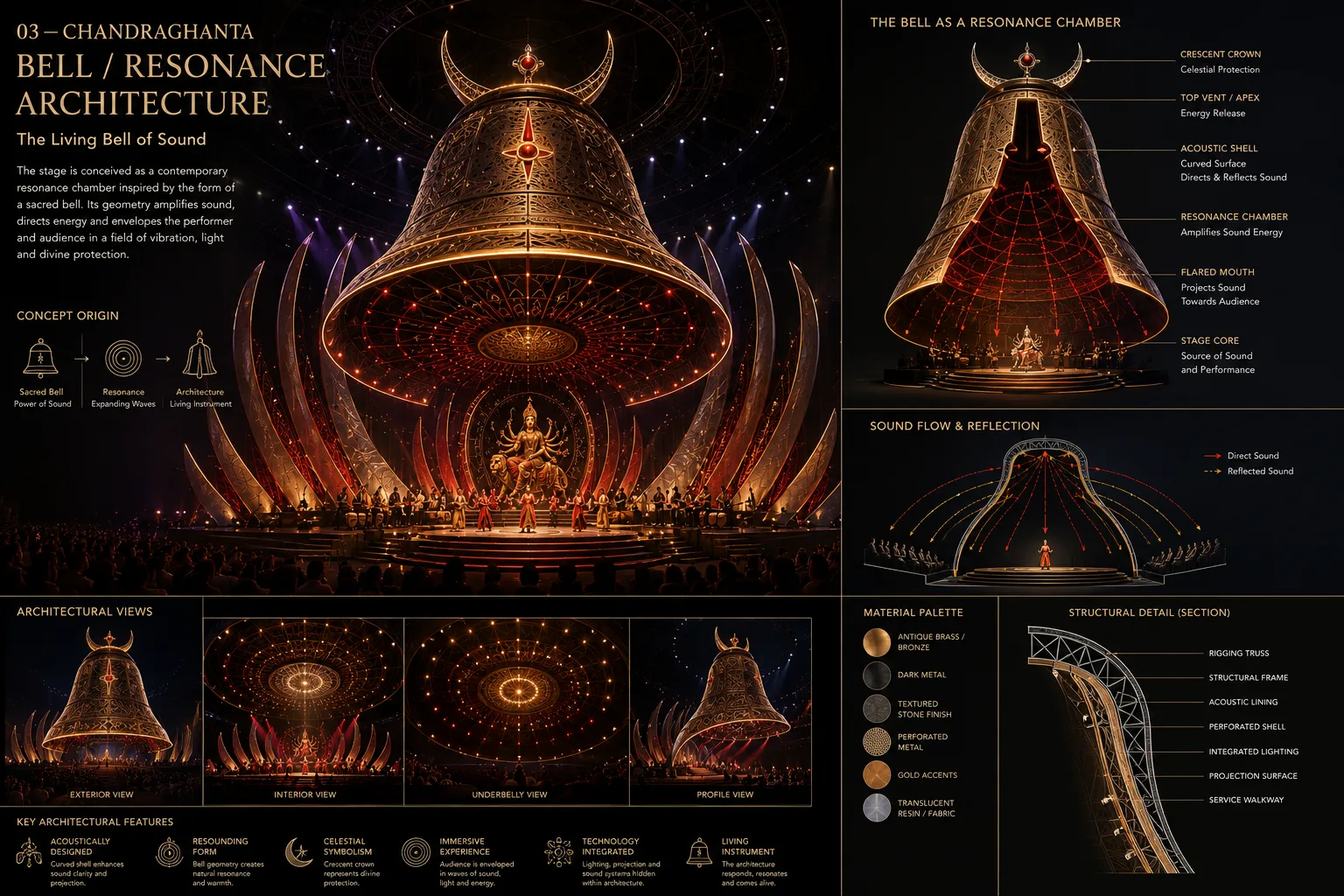
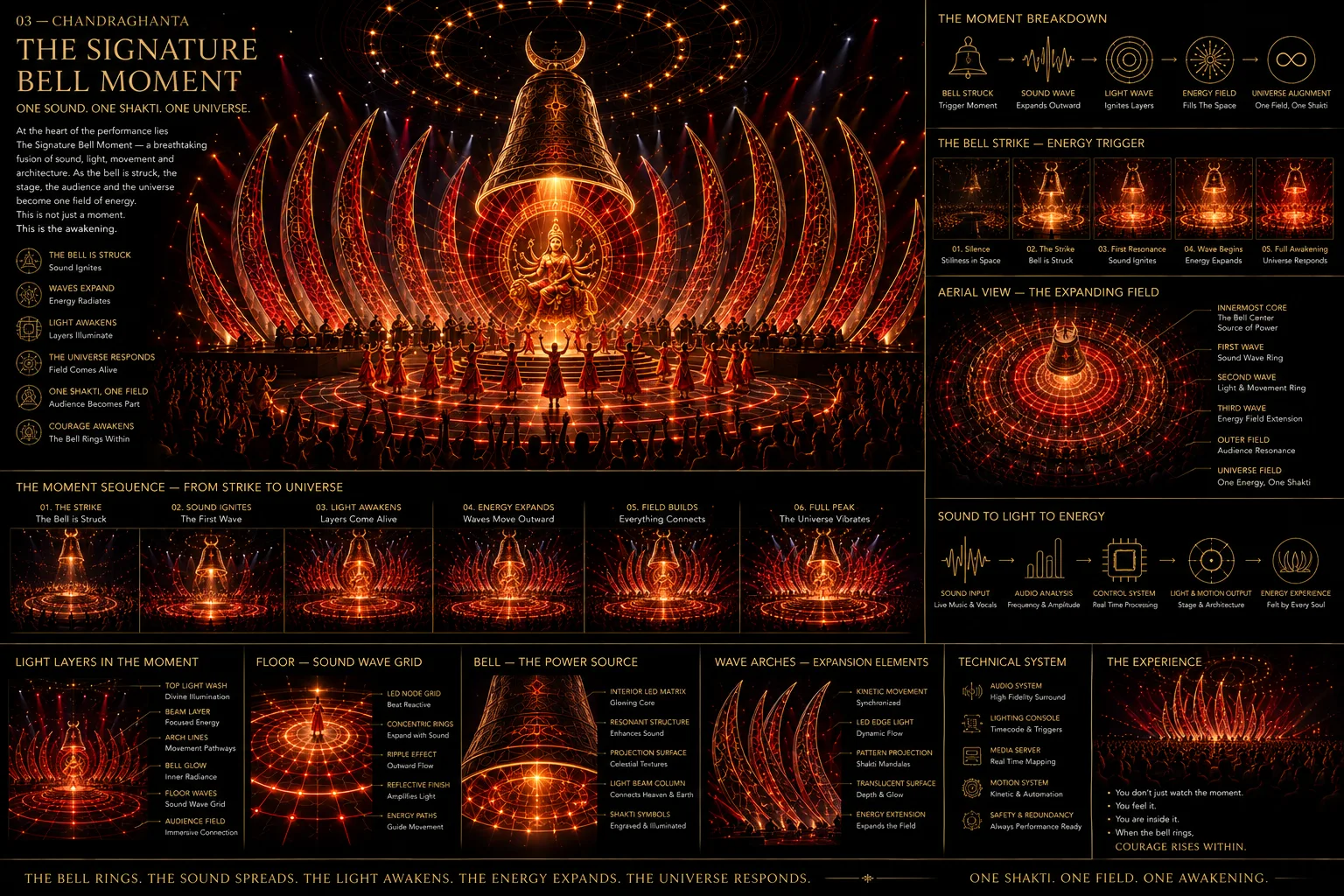
The bell is the primary spatial idea. Instead of suspending an ordinary bell above a conventional platform, the study exaggerates its scale until it feels like an inhabitable sound chamber. The flared lower profile turns toward the performers and the audience, while a warm bronze finish gives visual density against the dark stage.
Its possible acoustic role is conceptual: the images propose a resonant geometry and a multimedia bell moment, not measured amplification or a validated acoustic design. Any physical suspended structure would require independent structural engineering, rigging design, load assessment and acoustical study.
02 — The crescent as an architectural threshold
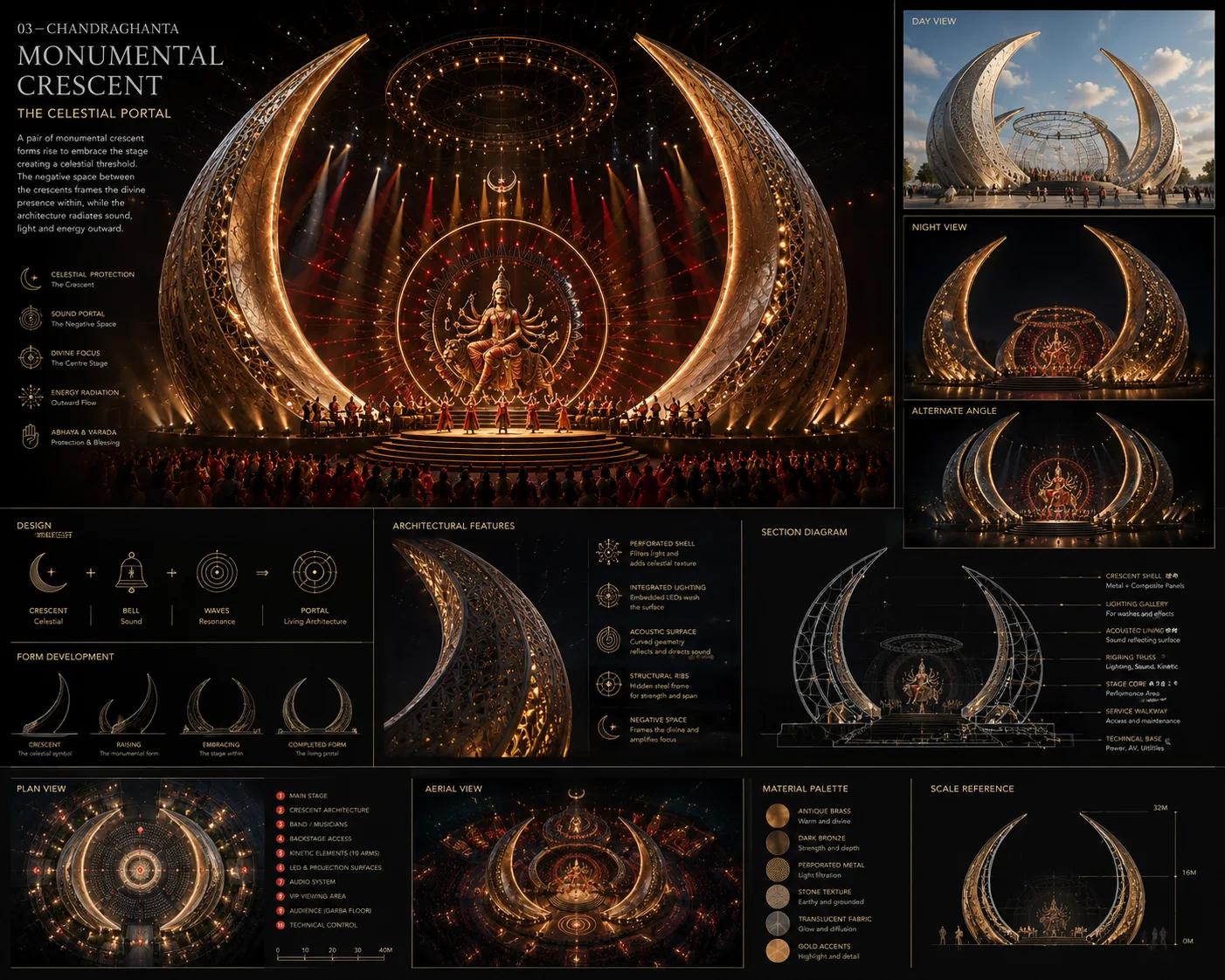
Chandraghanta’s crescent symbol inspired a second geometry: a pair of large sculptural crescents enclosing the stage. Their negative space focuses attention on the central image, while their textured and perforated skins allow controlled light to pass through. These forms are intentionally imagined at a monumental scale so they read as architecture, not as oversized stage props.
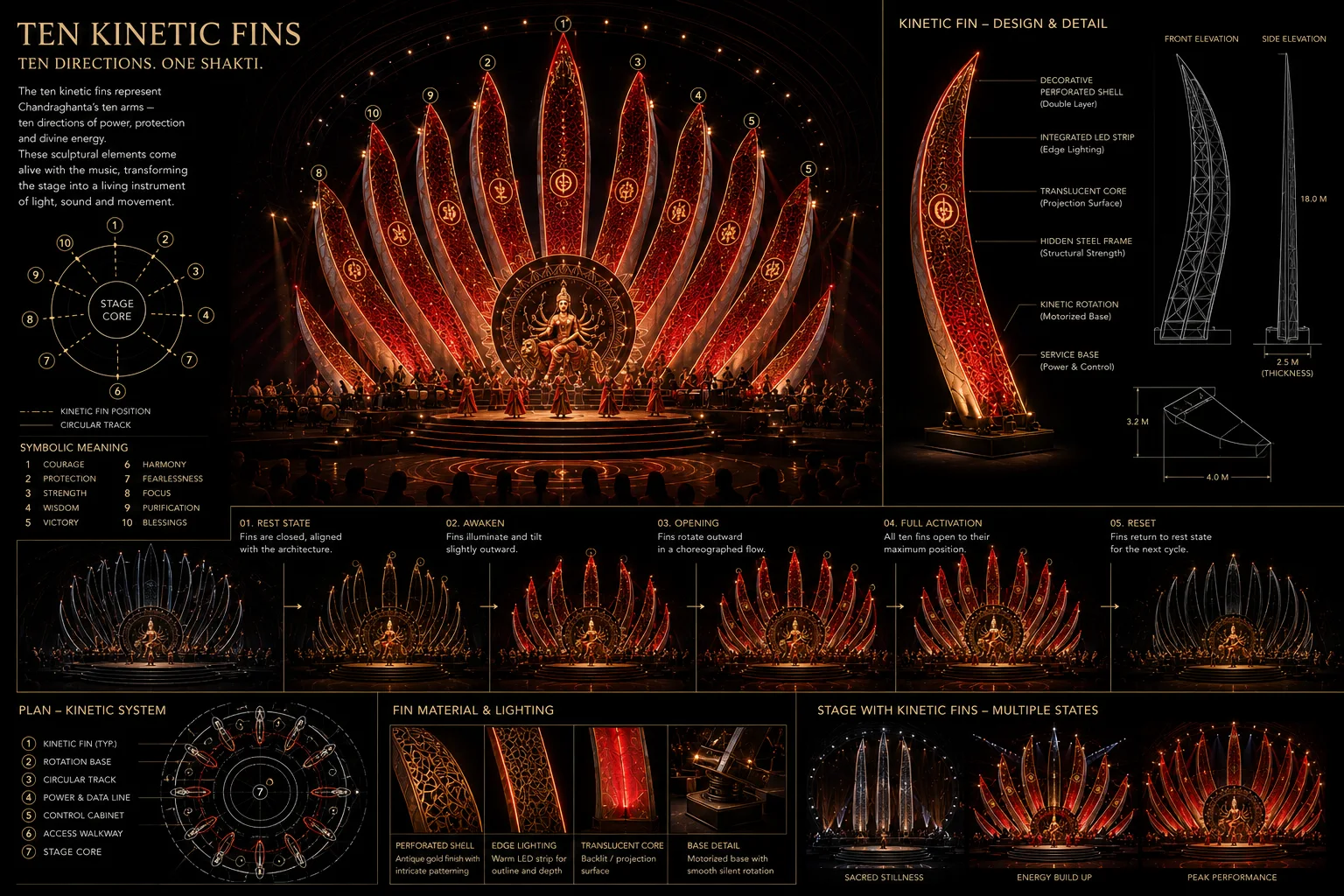
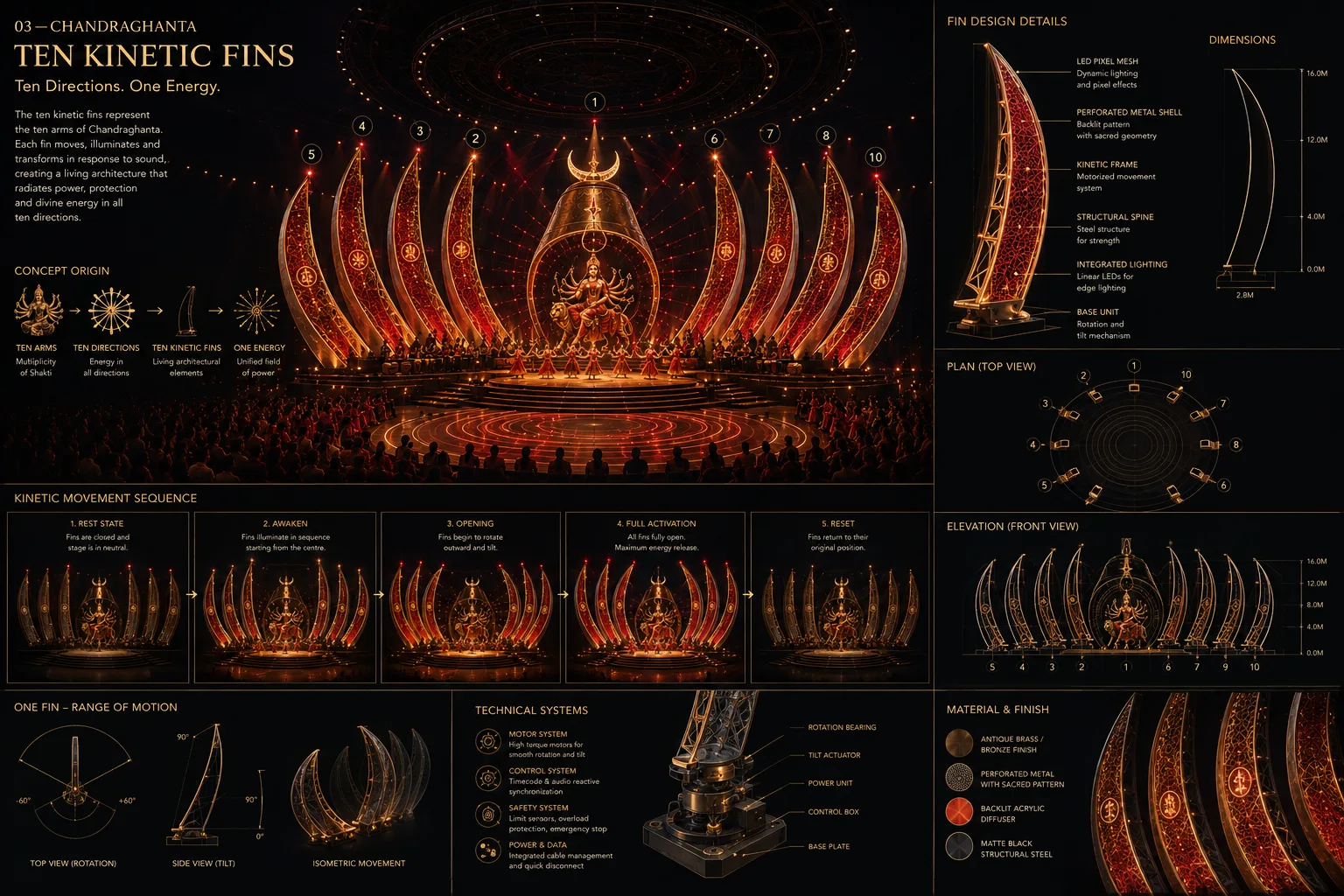
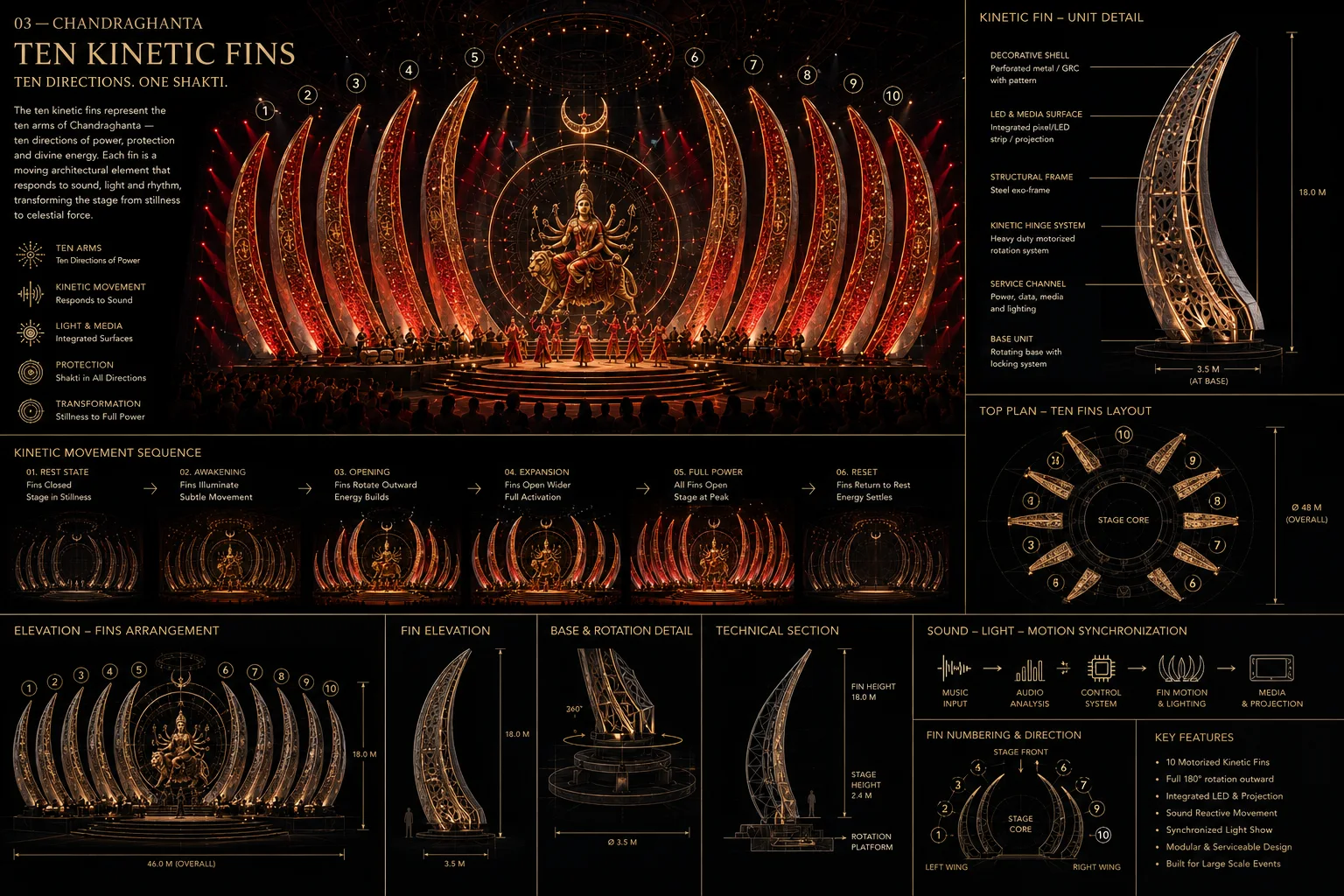
03 — Ten kinetic fins: ten directions, one energy
The next element is an array of ten fins surrounding the stage. The concept draws an abstract connection between Chandraghanta’s arms and the directions of Shakti, translating multiplicity into repeated architectural members. Each fin could hold patterned surfaces, translucent inserts, LED edges and projection layers.
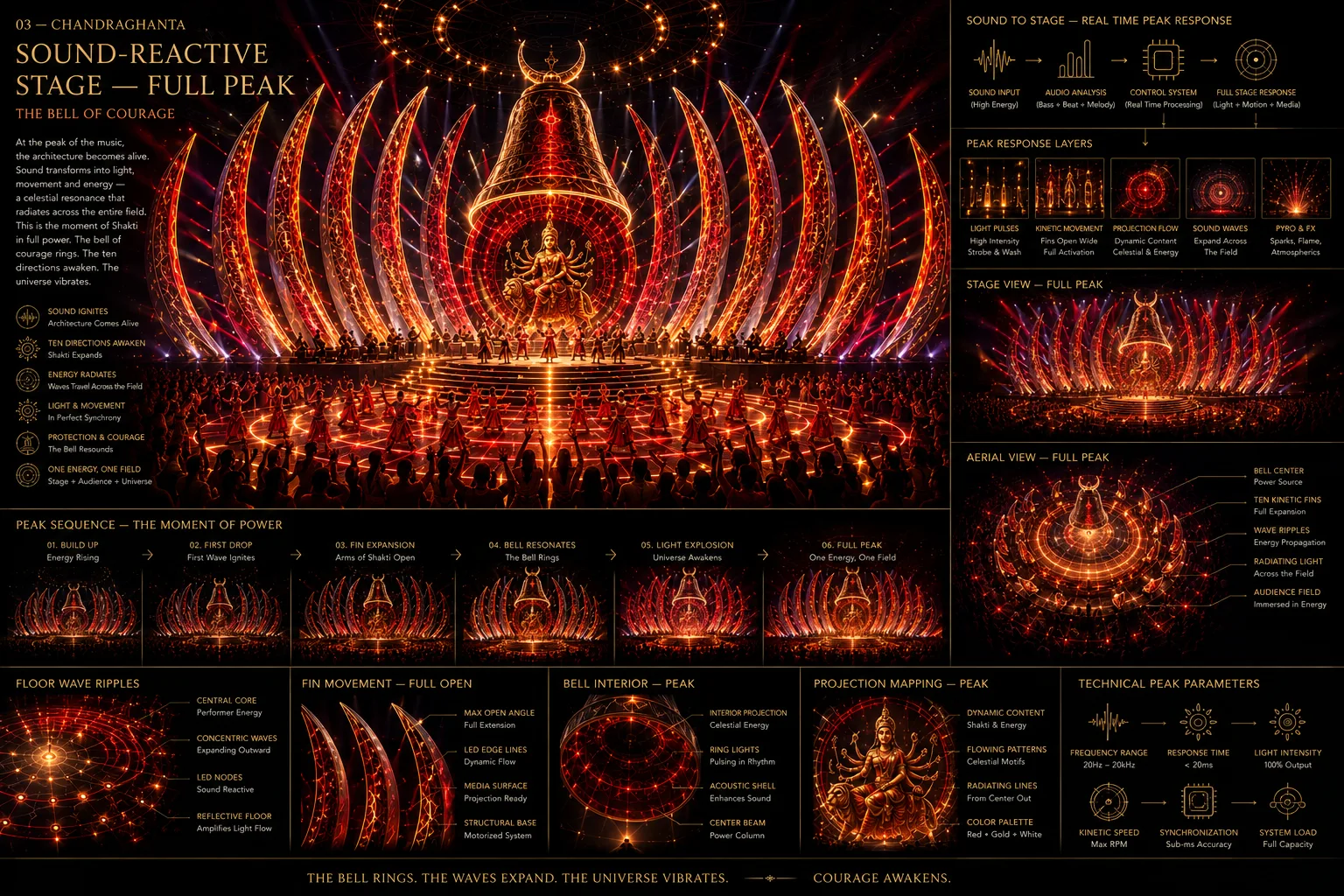
In the proposed performance sequence the fins begin in a restrained state, slowly illuminate and open outward as the sound increases. The visual studies suggest several stages of movement; they are not approved mechanism drawings. The number, travel arc, motor ratings, emergency stop behaviour, safeguards and public clearances must all be resolved if the idea advances beyond the conceptual stage.
04 — The sound-wave floor
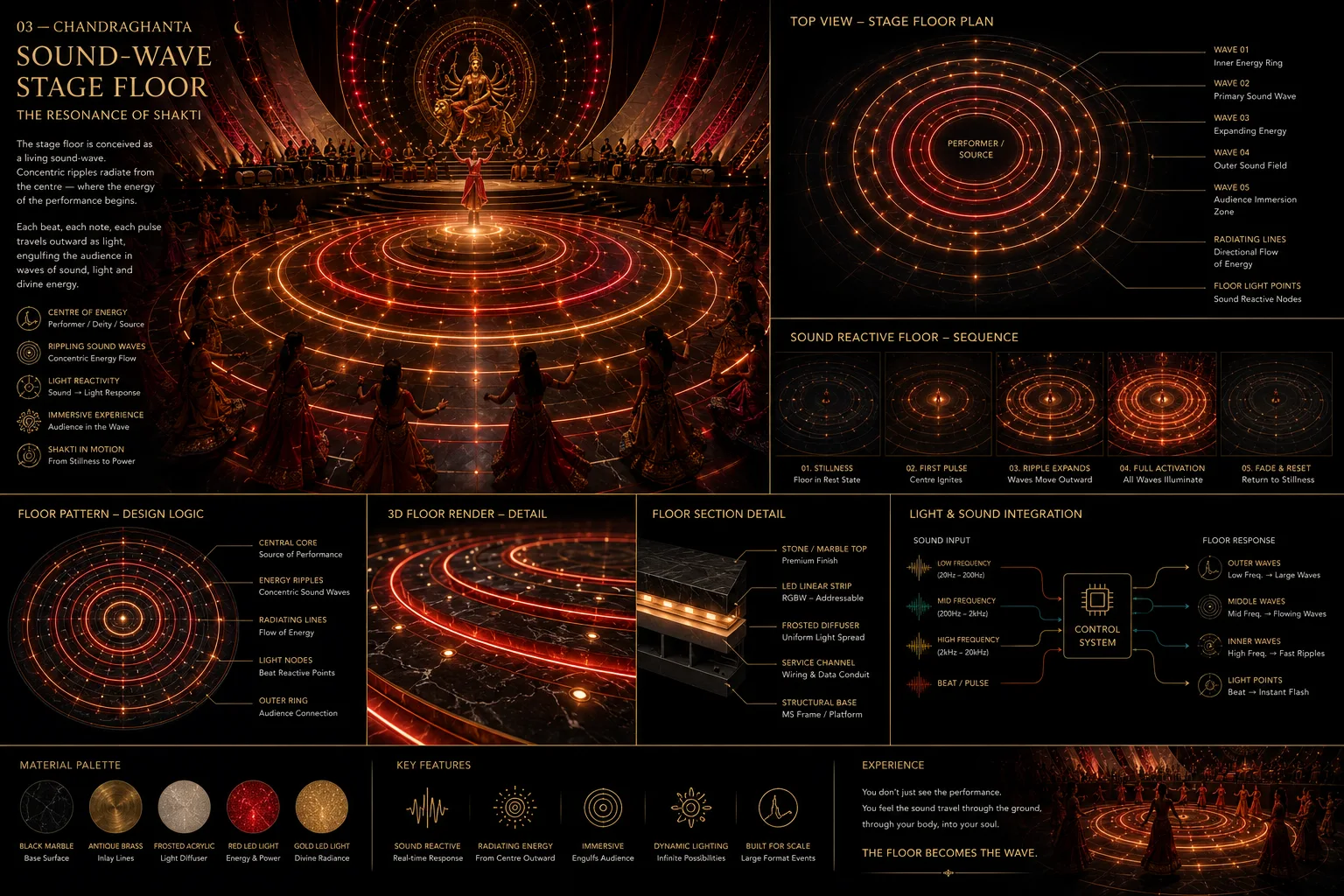
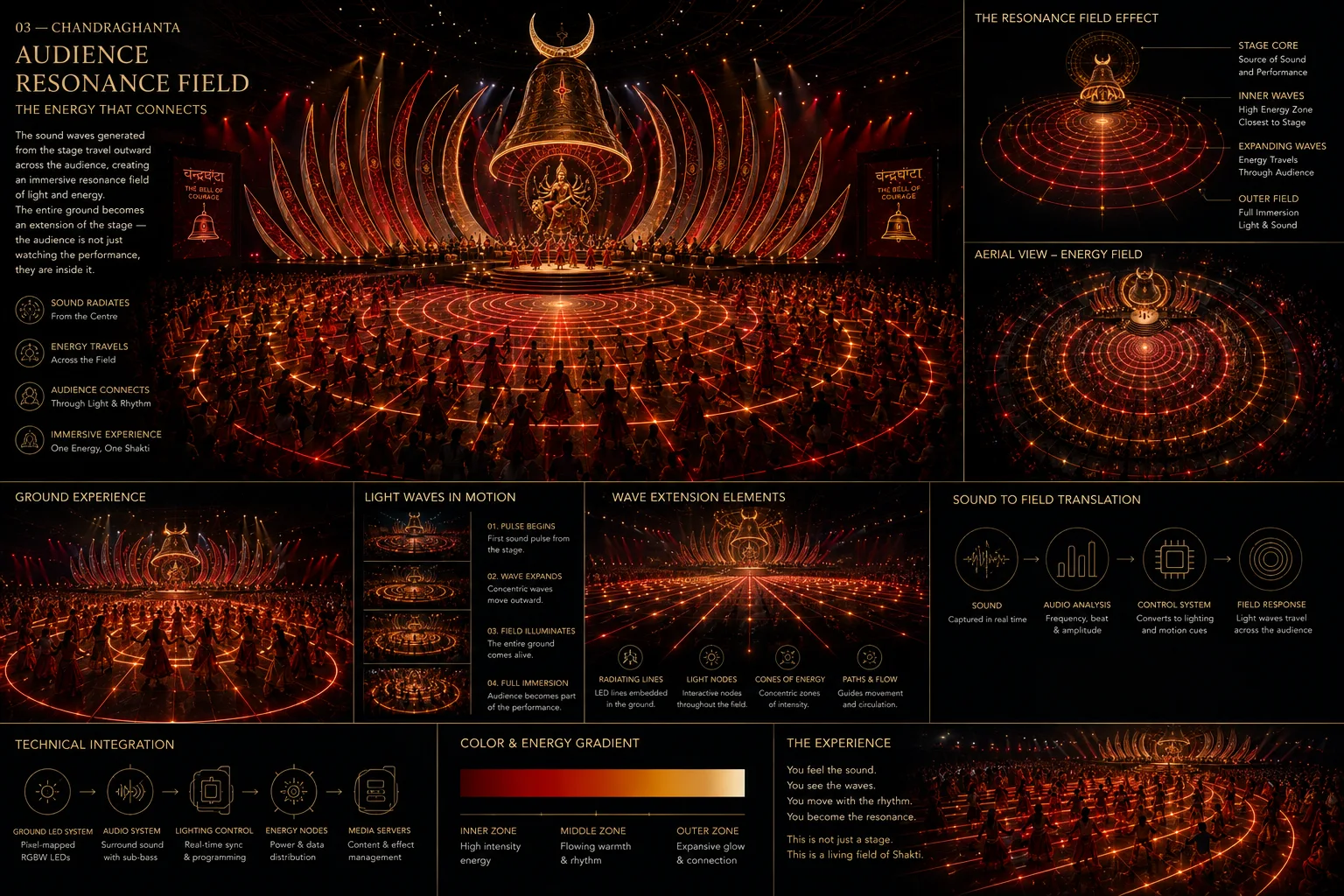
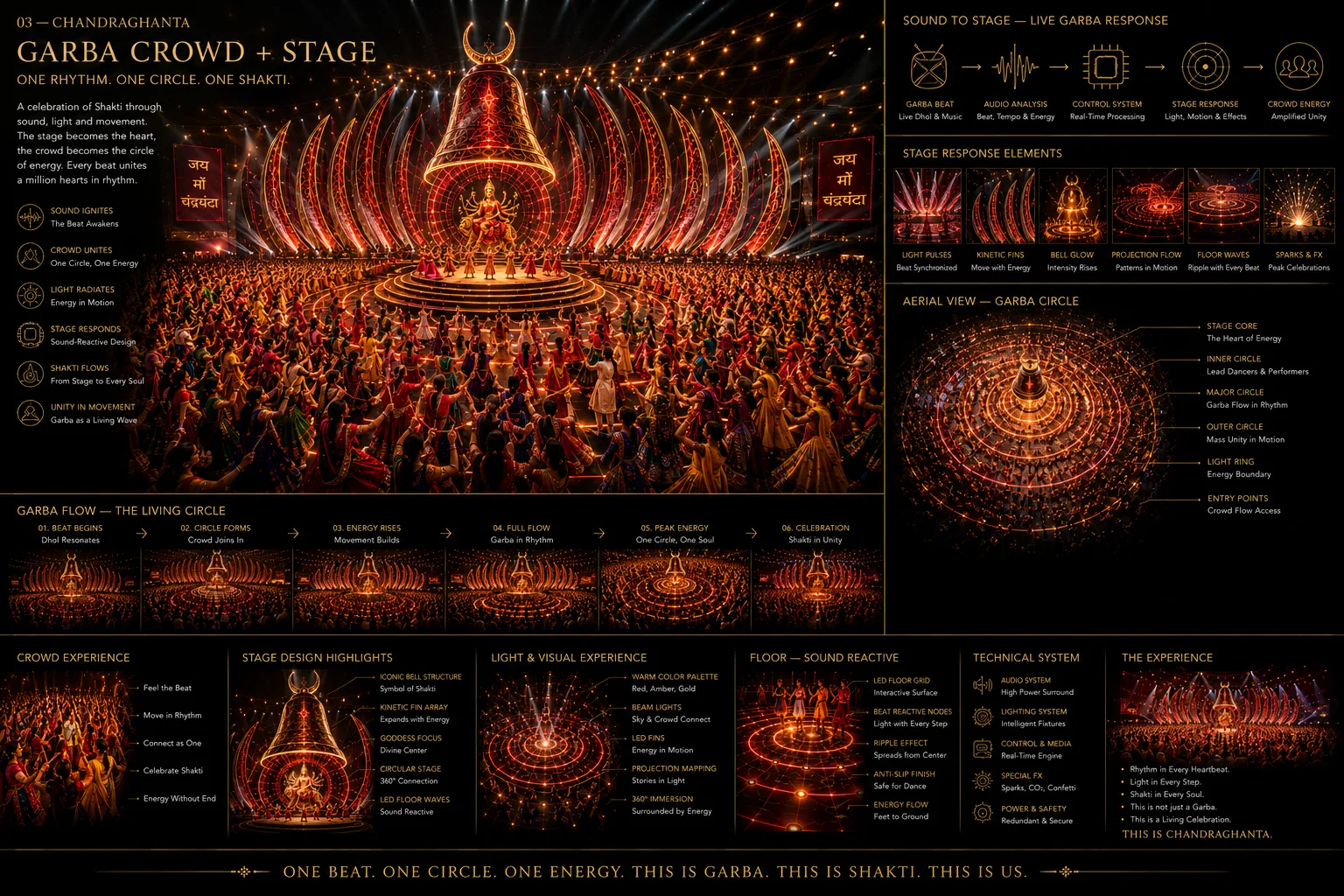
At ground level, the design develops the sound idea as a series of concentric circles. Light begins at the performer and radiates toward the dance floor. With each beat, the floor appears to send a new pulse outward. Small light nodes and ring patterns turn the performance surface into a graphic representation of resonance.
In an eventual technical study, the flooring would need to remain genuinely suitable for dancing, with appropriate slip resistance, cable management, power protection, trip-free detailing and safe access to any embedded lighting. These images describe the spatial experience and visual sequencing only.
05 — The audience becomes the resonance field
The audience is not an incidental background. This stage is imagined as a participatory circle: sound travels from the performance and the lighting follows, drawing the wider Garba audience into a shared rhythm. Rather than keeping spectacle only onstage, the concept treats the public realm as an extension of the performance field.
06 — The awakening: sound, light and motion
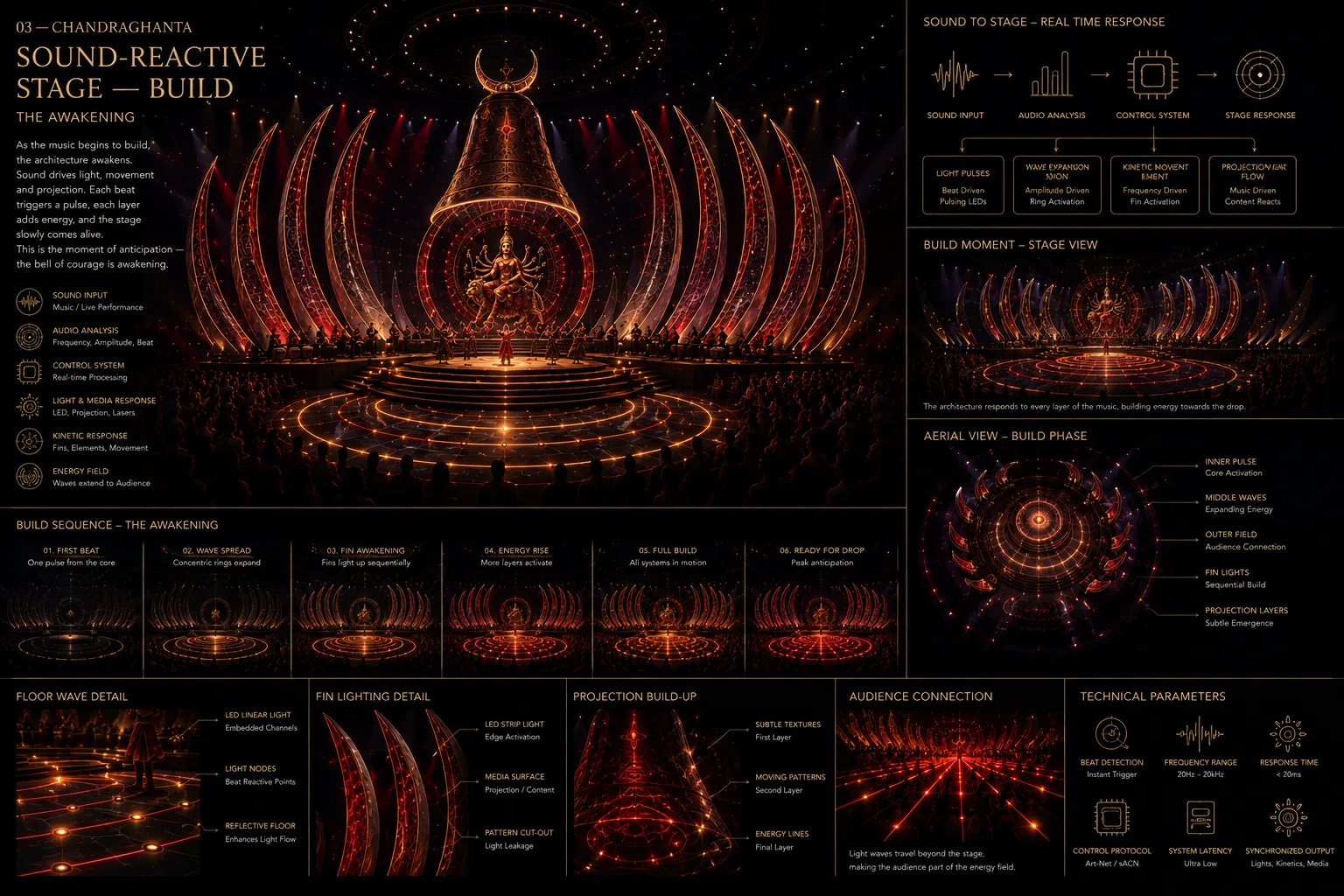
The dramatic language depends on an unfolding sequence rather than maximum brightness all the time. At the beginning, the bell remains dim, the fins are quiet and the floor holds only a trace of light. The first beat introduces the initial pulse. Repeated rhythms activate ring after ring, while the illuminated fin forms appear to unfold. At the crescendo, the bell, crescents, moving forms and crowd share the same visual energy.
Stillness → First Pulse → Bell Resonance → Fin Awakening → Energy Expansion → Full Peak.
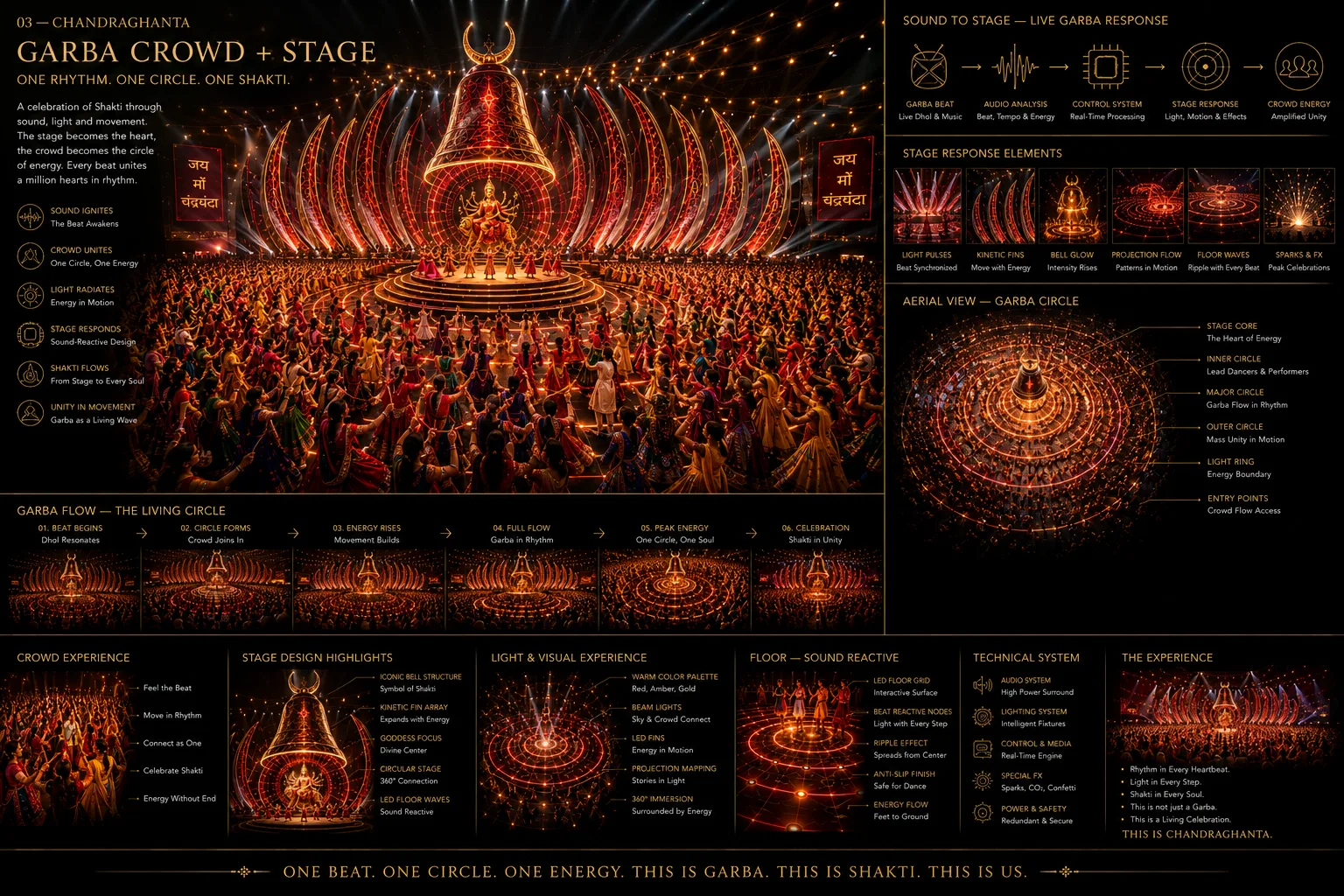
07 — The masterplan: from single stage to the entire venue
A responsive stage must still work as an event environment. The aerial concept plan therefore studies the stage core and concentric audience fields together with access routes, event support, backstage and control positions, vendor zones and possible service circulation. The premise is that circular movement and the visual identity should reinforce each other rather than compete.
All dimensions and crowd assumptions shown in the conceptual drawings remain unverified. No actual venue, geotechnical report, crowd simulation or structural calculations are implied. Safety, emergency exits, sound exposure, crowd control, accessibility and construction feasibility would require formal design development with the venue and relevant professionals.
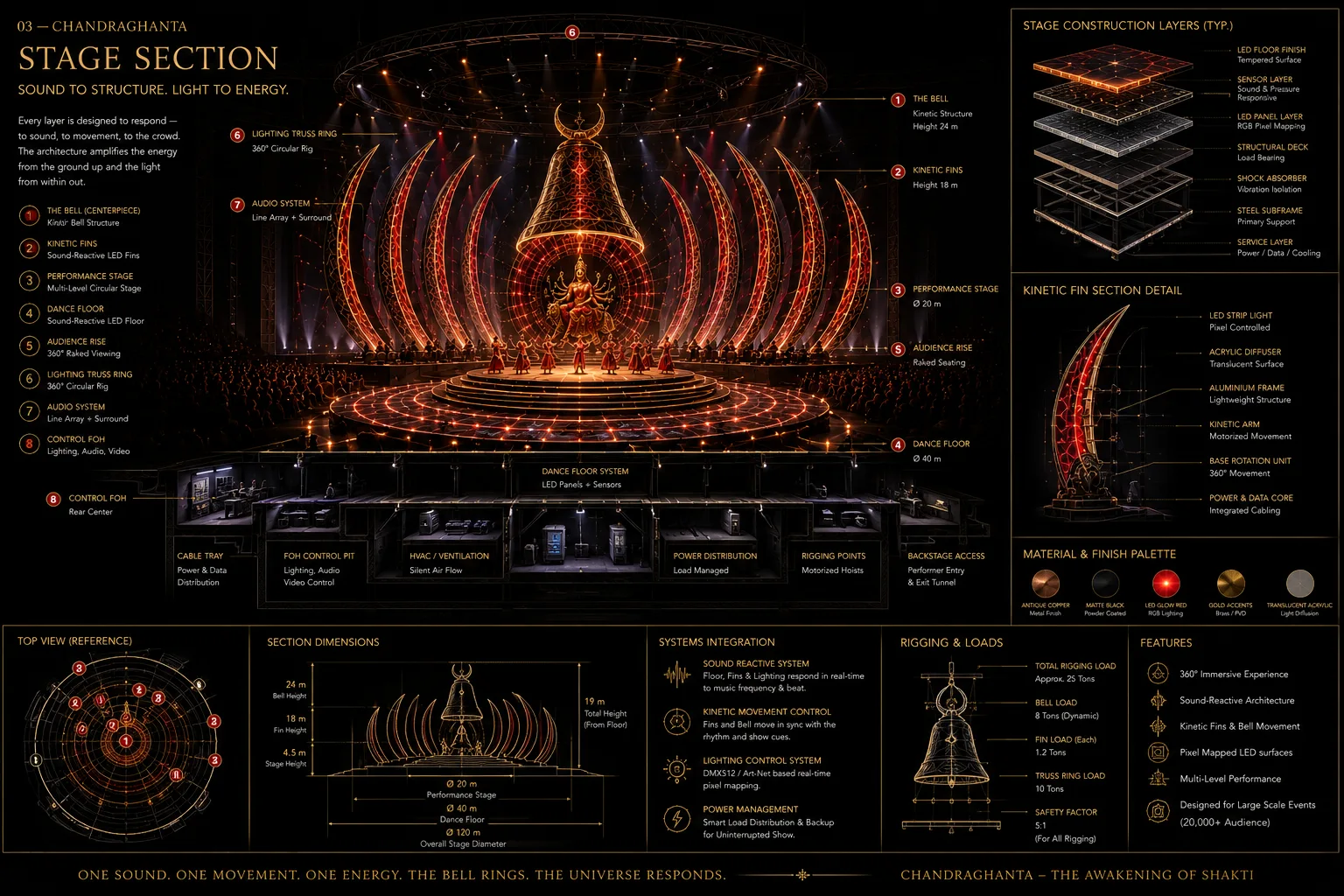
08 — From image to buildable systems
The section study proposes a layered system: a stage deck and public floor, sculptural fins, the suspended bell, a lighting rig and service access below and behind the performance zone. It is a communication drawing for the design intent, not a construction approval. The next step in a commissioned version would be to separate each element into its structure, scenic skin, lighting, power, control, maintenance access and installation package.
Design language: bronze, ember and motion
The restrained palette is anchored in antique bronze, dark metal and textured stone, with red-amber light providing the energy. Light passes through perforated surfaces, catches the edges of the fins and repeats across the floor. Red is used as a dynamic effect rather than as a uniform decorative surface, while gold defines the bell and ceremonial focal points.
The result is an energetic counterpoint to the previous world, Brahmacharini — the Sanctuary of Devotion. Where Brahmacharini encourages stillness, Chandraghanta invites awakening and participation. Together with the Shailaputri mountain threshold, these three environments establish three distinct beginnings: arrival, contemplation and energy.
Continue to 04/09 Kushmanda — The Cosmic Creator, where resonance gives way to the story of the first spark and the emergence of a universe. Explore the complete Navdurga — Nine Worlds of Shakti exploration or see more work from Set Craft Atelier.
Conceptual visualisations and indicative design-development diagrams. Kinetic, acoustic, lighting, crowd-capacity and structural features are ideas for further validation, not execution-ready specifications.