Set Craft Atelier · Navdurga Spatial Design Exploration · World 04 / 09
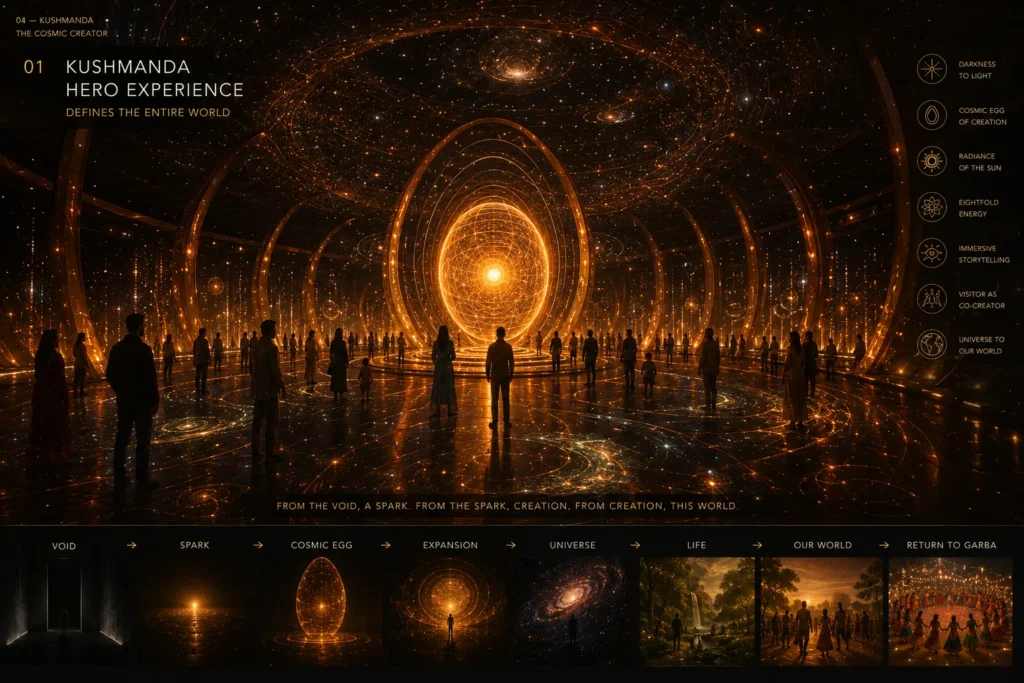
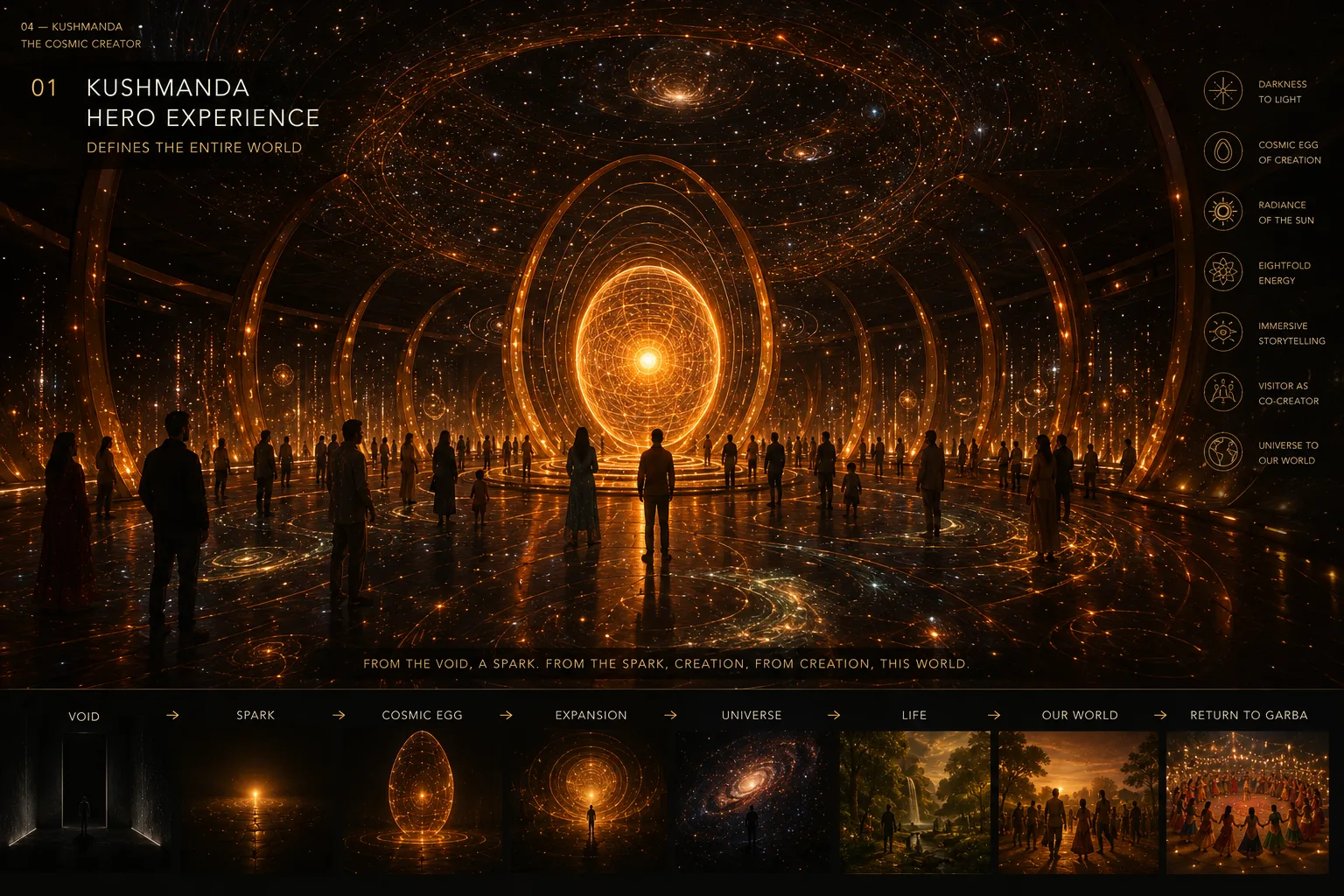
From the void, a spark. From the spark, creation. From creation, the world.
For the fourth chapter of our Nine Worlds of Shakti exploration, we study Kushmanda through the idea of cosmic creation. The premise is simple: before anything can appear, there must be space for the first light to matter. Rather than treating mythology as ornament, this spatial concept proposes a sequence in which darkness, a single spark, radiating warmth and the formation of a luminous universe shape a visitor’s journey.
Kushmanda’s association with the creative energy of the cosmos informs a vocabulary of the sun core, cosmic egg, eight paths, expanding rings, reflective chambers and a garden of life. The visitor is gradually drawn from absence into possibility, then into a universe in which their own movement could become part of the light.
01 — Before creation: The Void
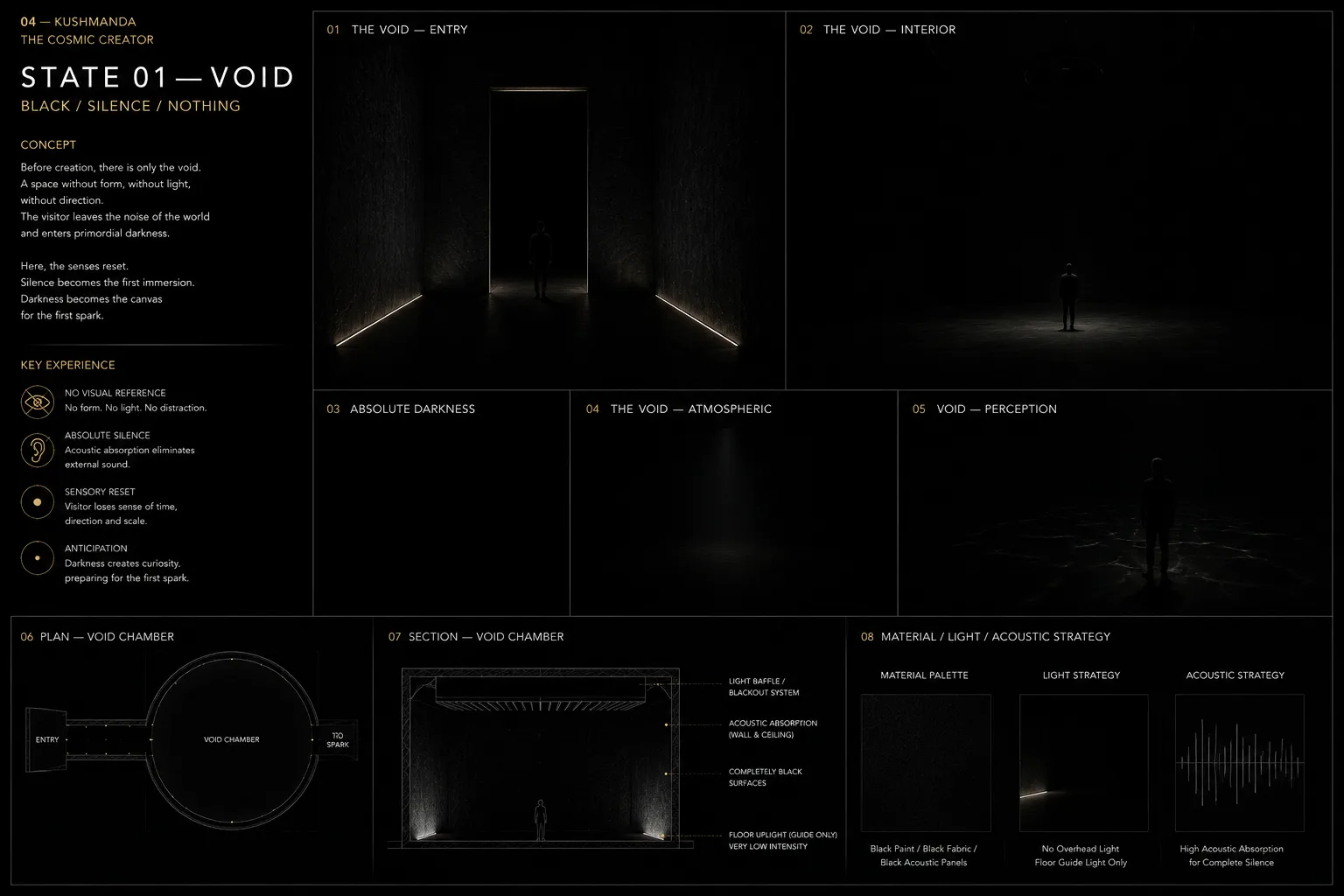
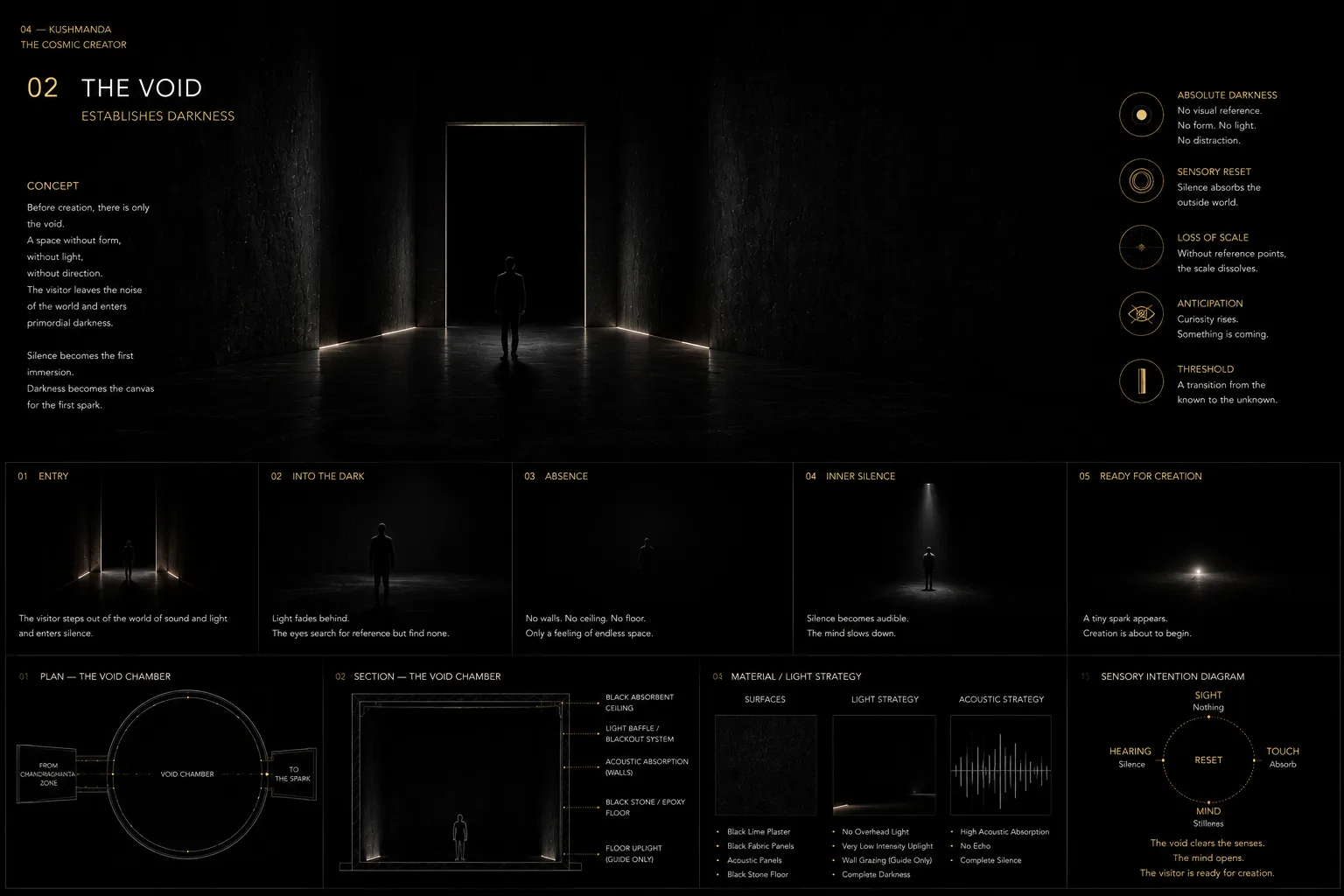
We begin with deliberate subtraction. The void is an almost black chamber, conceived with minimal reference points, deeply absorptive surfaces and a muted sound field. A faint floor-level guide light gives orientation without revealing the whole volume. The intention is not to disorient or endanger visitors, but to make the first appearance of light feel significant.
There are two linked readings: the entry threshold as a moment of transition, and the inner void as a pause in which light and spatial scale are barely legible. In an actual venue, accessible wayfinding, emergency illumination, supervision and a safe, clearly defined walking route would remain essential despite the visual darkness shown in the renders.
02 — The first spark and the birth of warmth
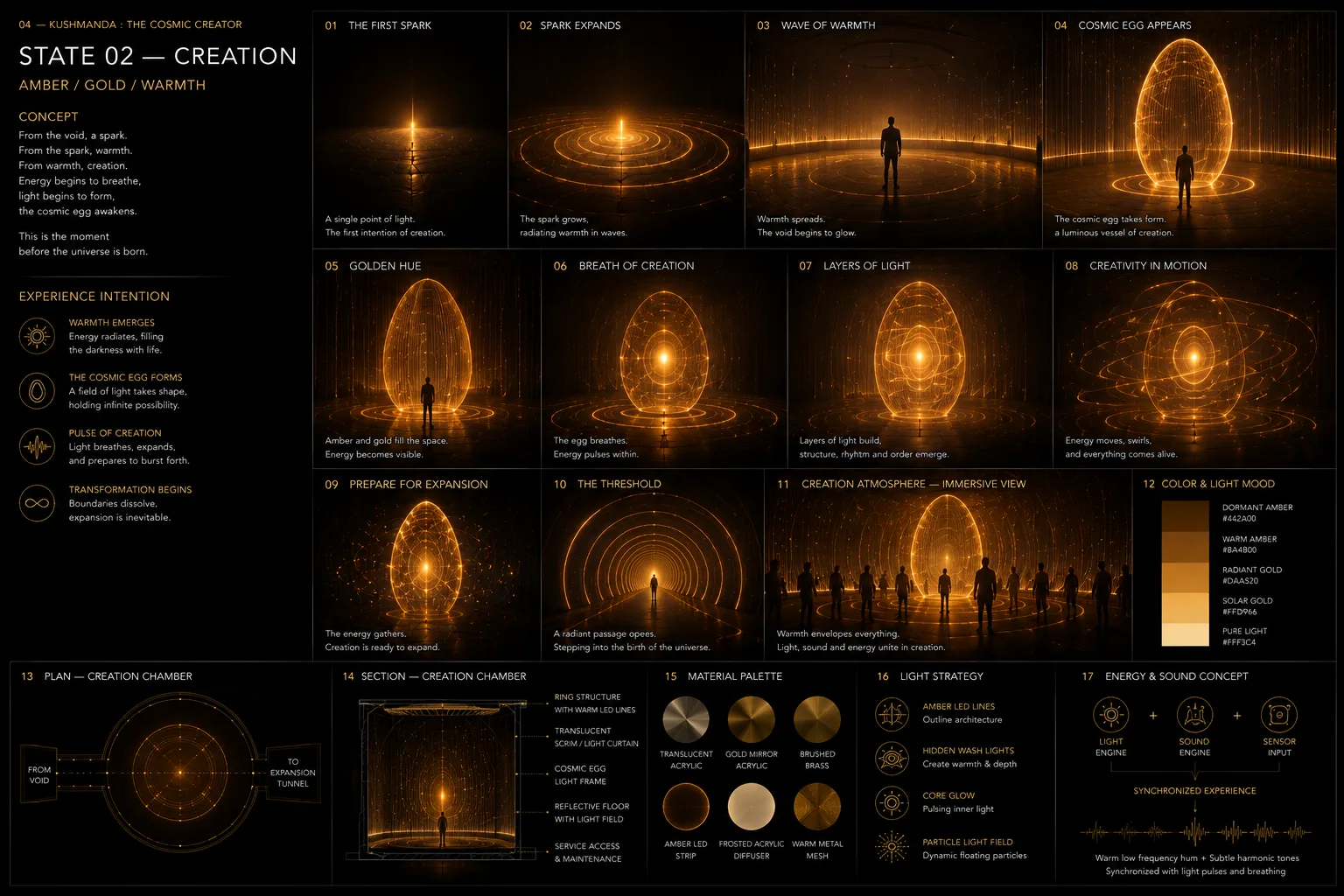
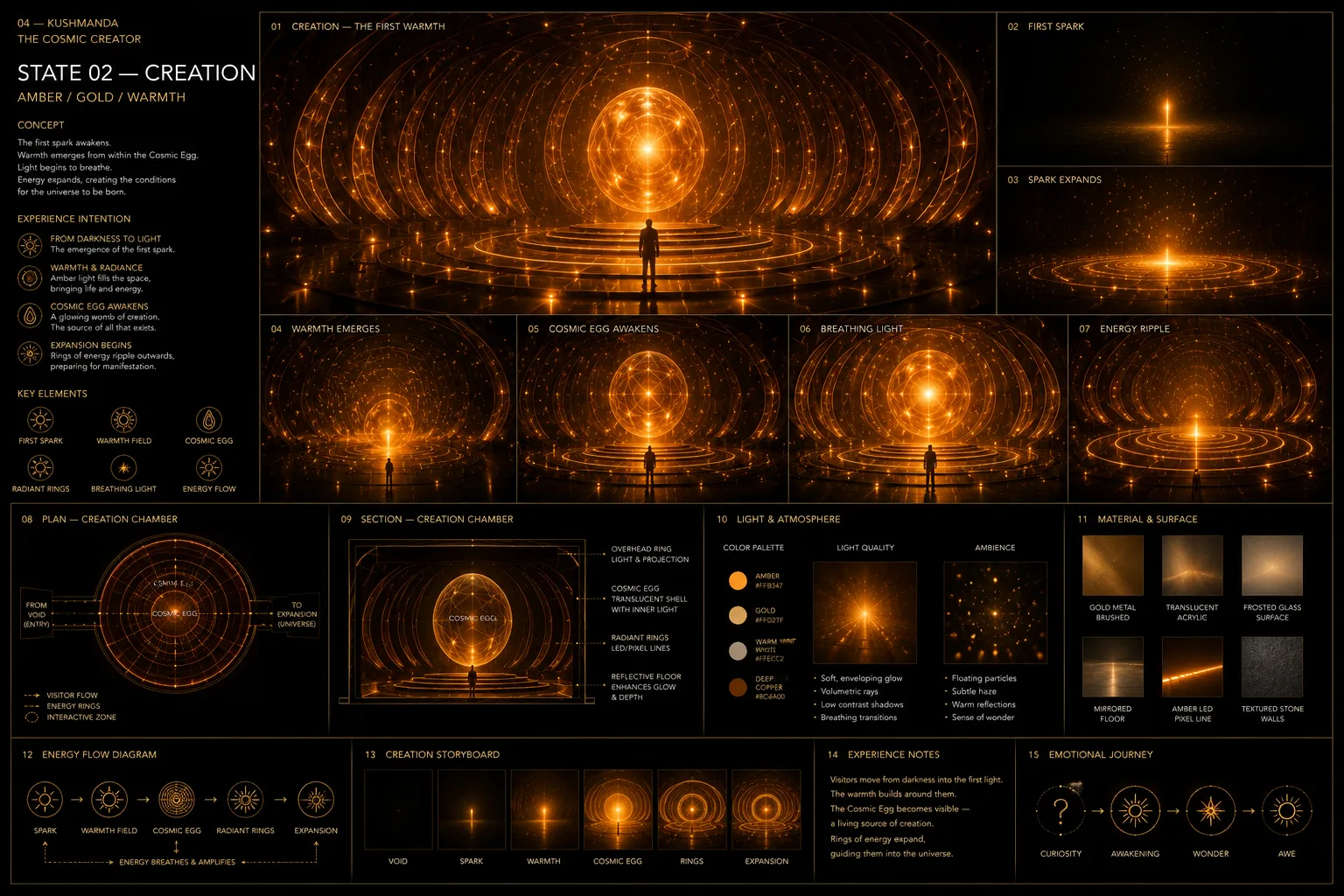
A point of light appears where there had been none. This is the dramatic trigger for the experience. The ambient colour rises gently from black through deep amber into gold, and a small circle of light becomes several rings. The early stages are intentionally restrained; creation should feel as though it is accumulating, not simply switching on.
Light, sound, fine reflection and moving image may work together here, with the intensity building as visitors progress. The images show the visual narrative, while media design, cueing, sensor logic and safe lighting levels would form a separate technical development package.
03 — The Cosmic Egg: architecture as the first form
At the centre of the creative sequence is a luminous, egg-like volume formed by layered light, concentric geometry and a transparent or translucent envelope. The enclosing structure is less about a literal object and more about an architectural form for possibility: something in which an entire universe appears to be held before it unfolds.
One immersive version surrounds visitors with giant luminous rings and projected energy patterns; another studies a more legible radial central installation. Both are visual directions within the same concept and would require scale, buildability, servicing and motion studies before a design is selected.
04 — Sun Core: the light that sustains
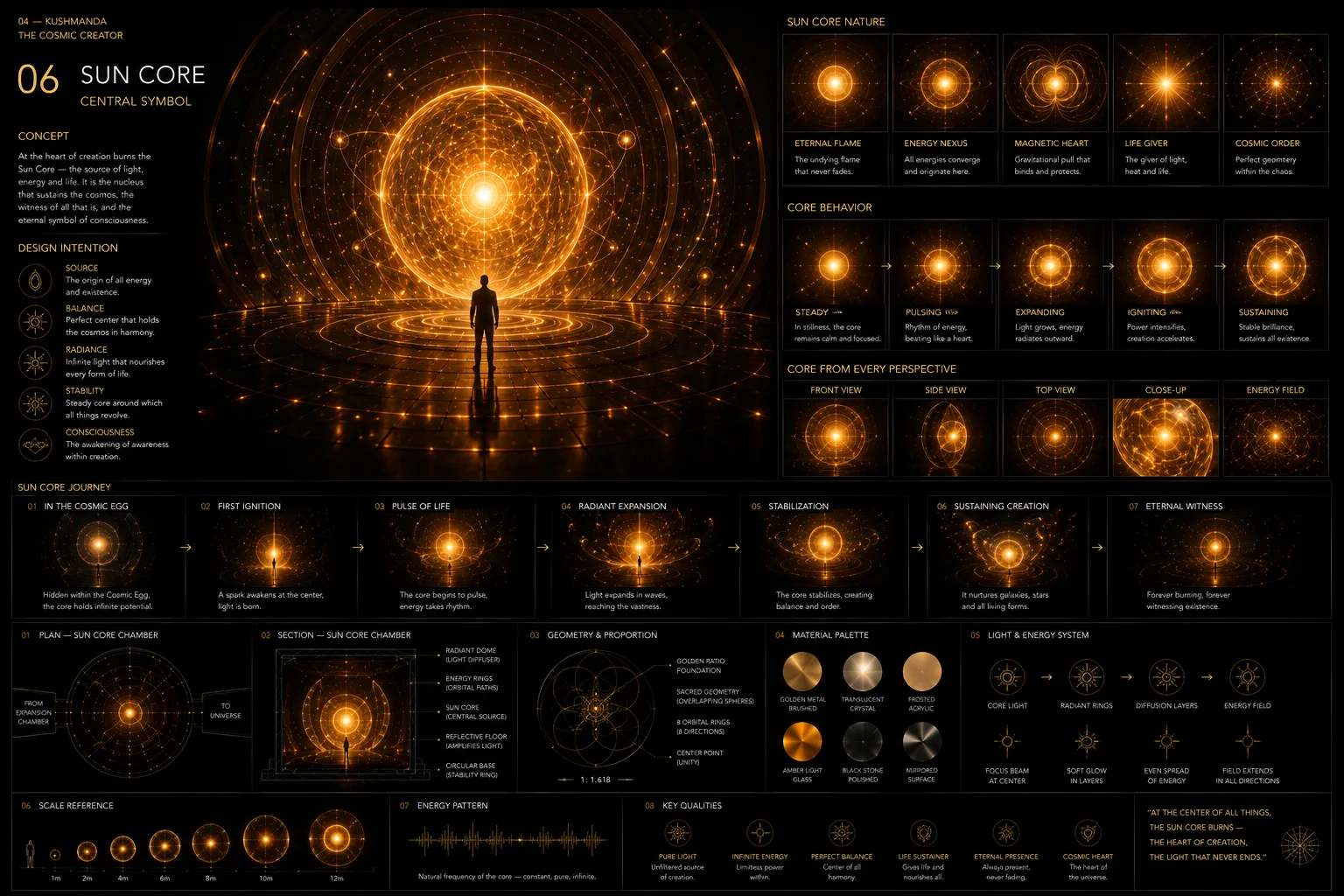
Once the cosmic egg has emerged, the experience shifts toward a central radiant core. This is conceived as the source of the illumination rather than an ordinary glowing prop. Rings, reflected points of light and layered diffusion create the impression of a field extending far beyond the visible core.
Brushed metallic finishes, warm amber light, dark mineral textures and controlled specular reflections keep the palette cohesive. These colours are used to communicate warmth and the emergence of form without flattening every chamber into the same visual treatment.
05 — Eight energy paths: turning symbolism into circulation
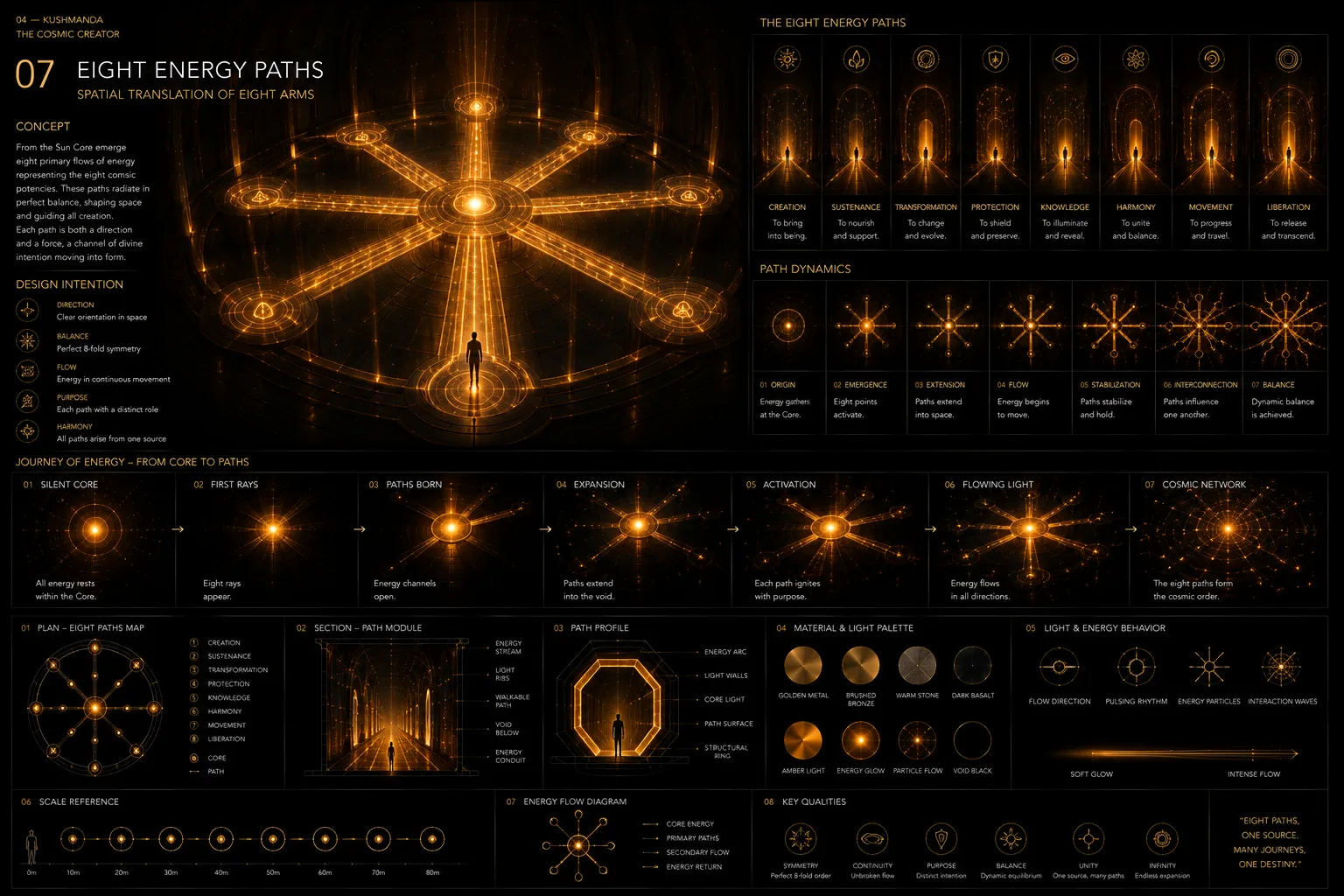
From the central core, eight radial paths extend outward. Their form is informed by Kushmanda’s eight-armed iconography and the broader idea of energy emanating from a common origin. Each path suggests a distinct quality, allowing the architecture to balance orientation with discovery. The radial order also introduces a clear way to understand movement between multiple experiential zones.
In planning terms, this is a conceptual network, not a measured circulation solution. The final pathway widths, loops, accessibility, evacuation access, structure, operating capacity and sightlines would depend on the site and visitor modelling.
06 — Universe, scale and the possibility of life
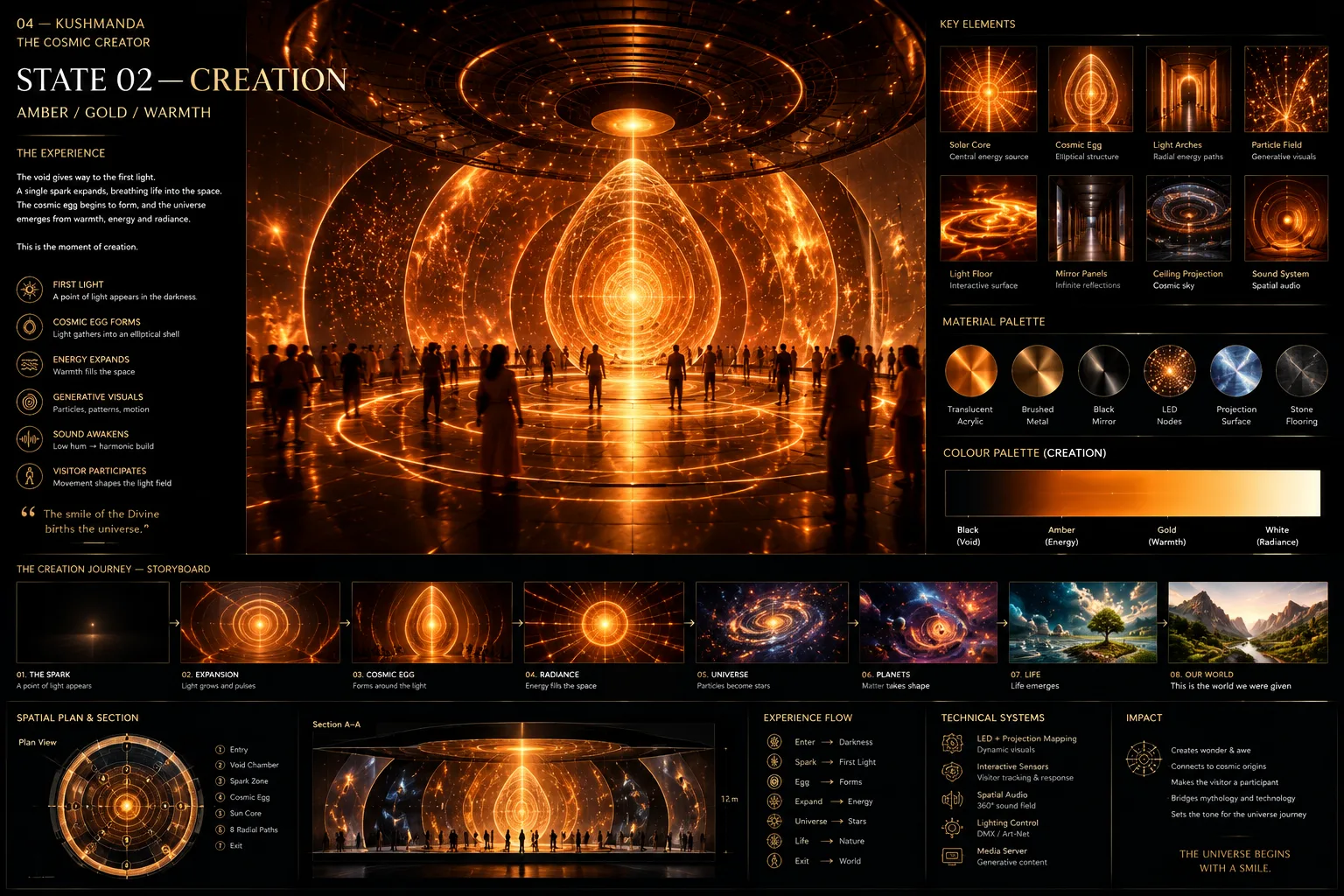
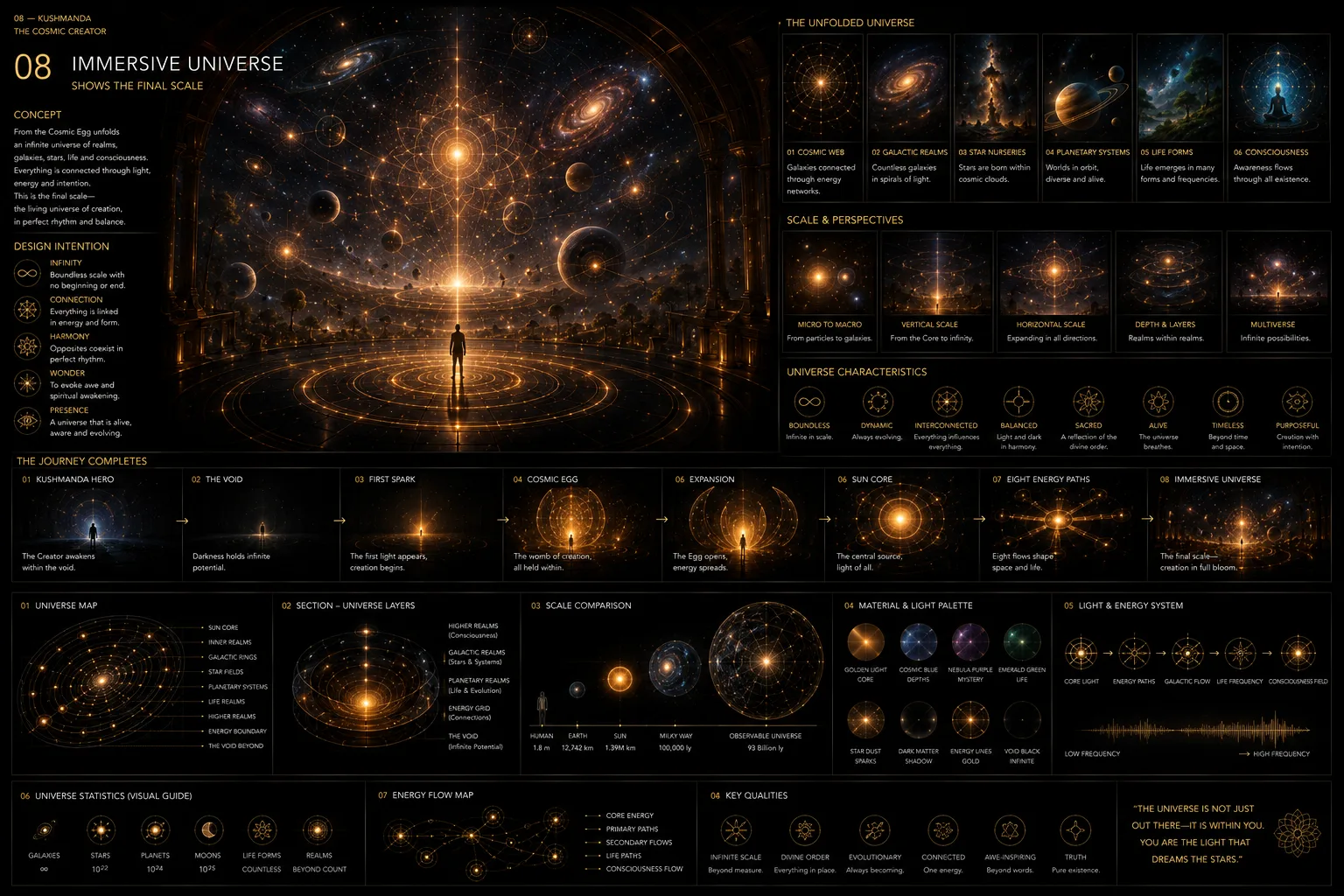
The experience broadens from one light source to a field of galaxies and planetary forms. Large projections, celestial geometry and layered visual depth allow the visitor to feel the change from an intimate chamber to a universe that cannot be seen in one glance.
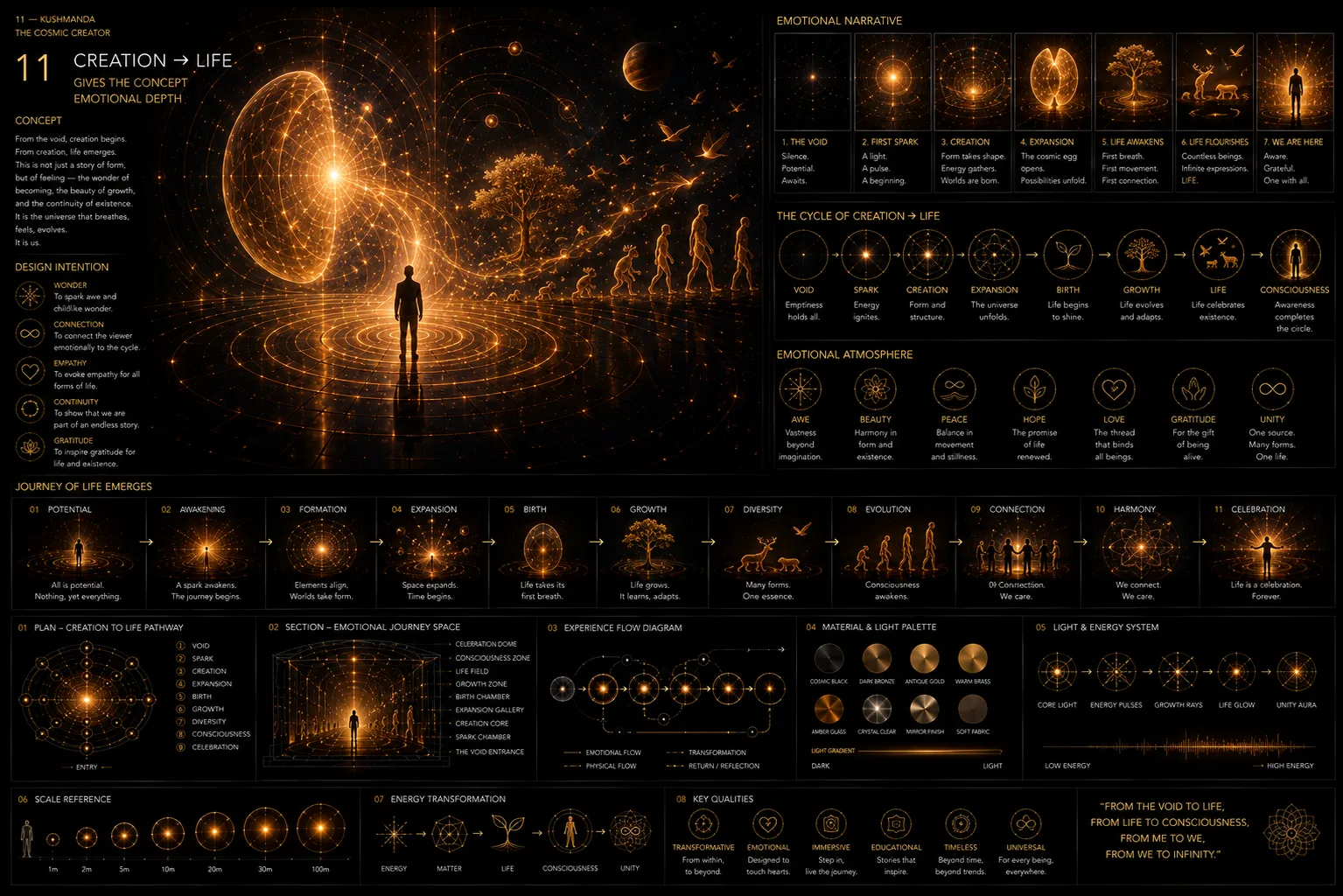
We then transition from cosmic geometry toward the imagery of life: light becomes form, form becomes nature, and the created universe becomes a world of growth and connection. This gives the sequence an emotional dimension beyond spectacle. It is not simply the birth of a universe; it is a journey toward belonging within it.
07 — Visitor participation and the infinity field
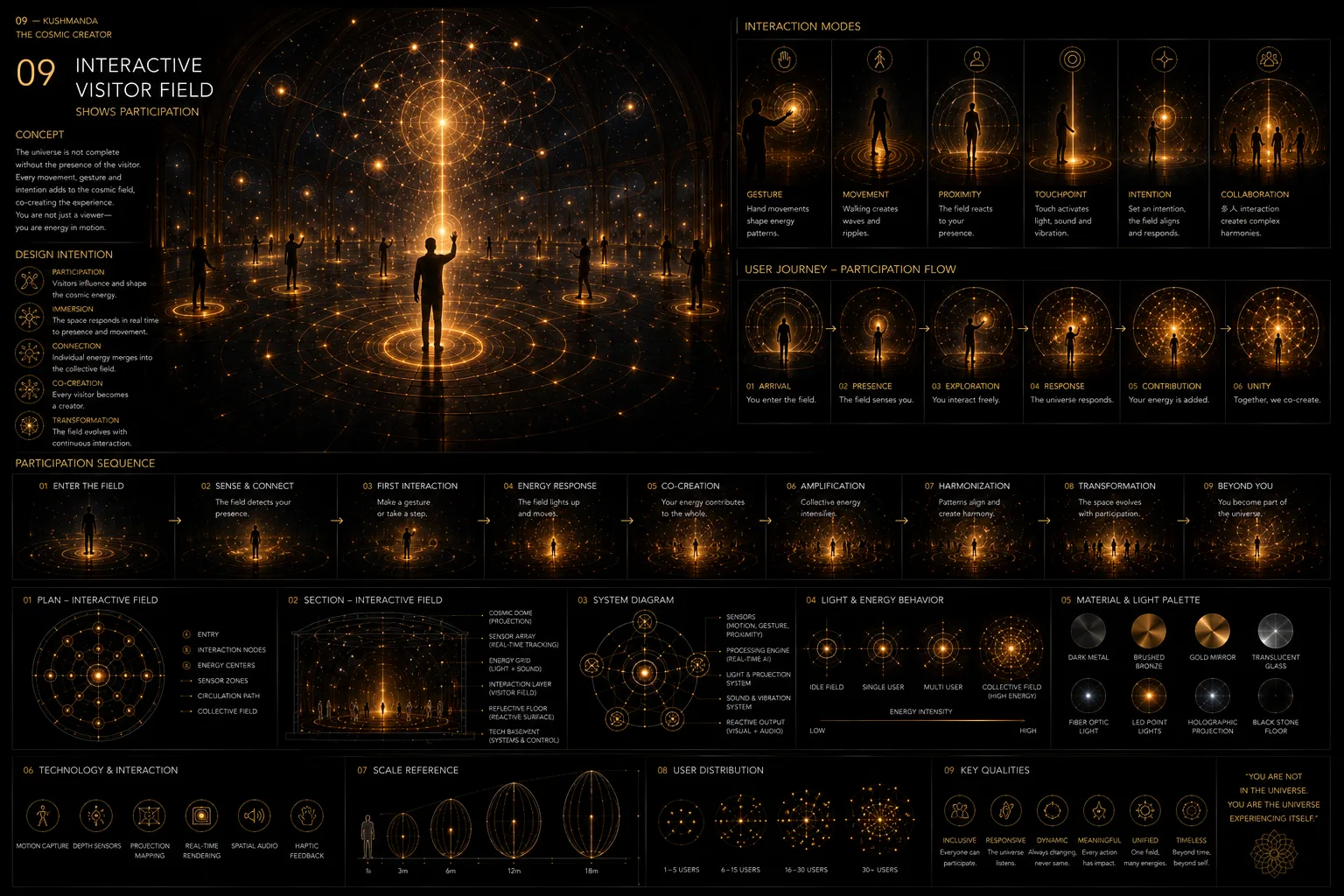
The visitor is invited to influence the light rather than just look at it. Interactive ideas include a floor that responds to footsteps, zones that become luminous when someone approaches, and gesture-driven light fields. Interaction should feel intuitive and generous, especially for families and people who choose not to participate actively.
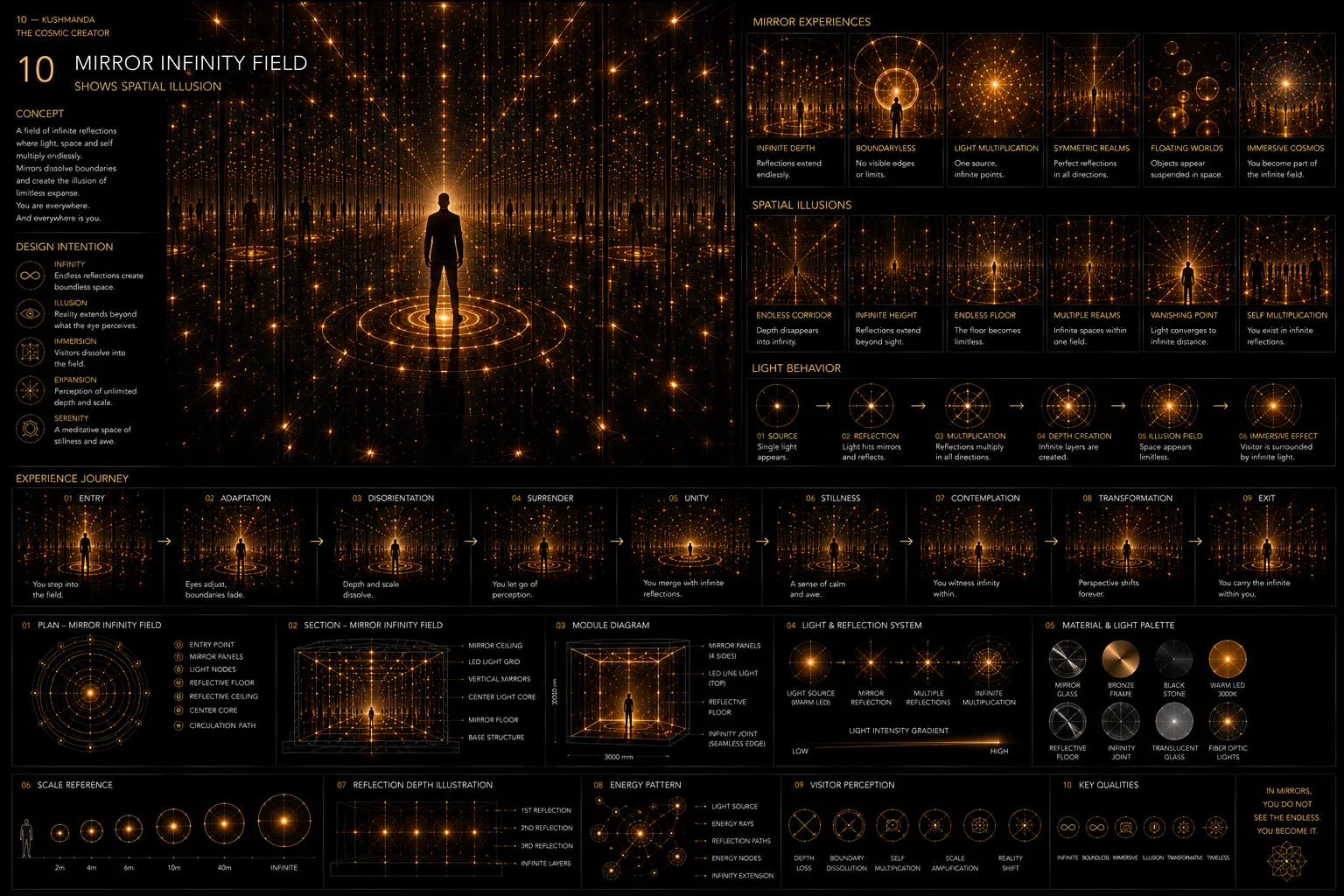
A related mirror infinity chamber uses repeated reflection and fine points of light to dissolve visible boundaries. It explores the paradox at the heart of the concept: one person within an apparently limitless universe. Reflective materials, lighting angles and visitor movement are critical here, and any mirrored floor treatment would need careful safety assessment.
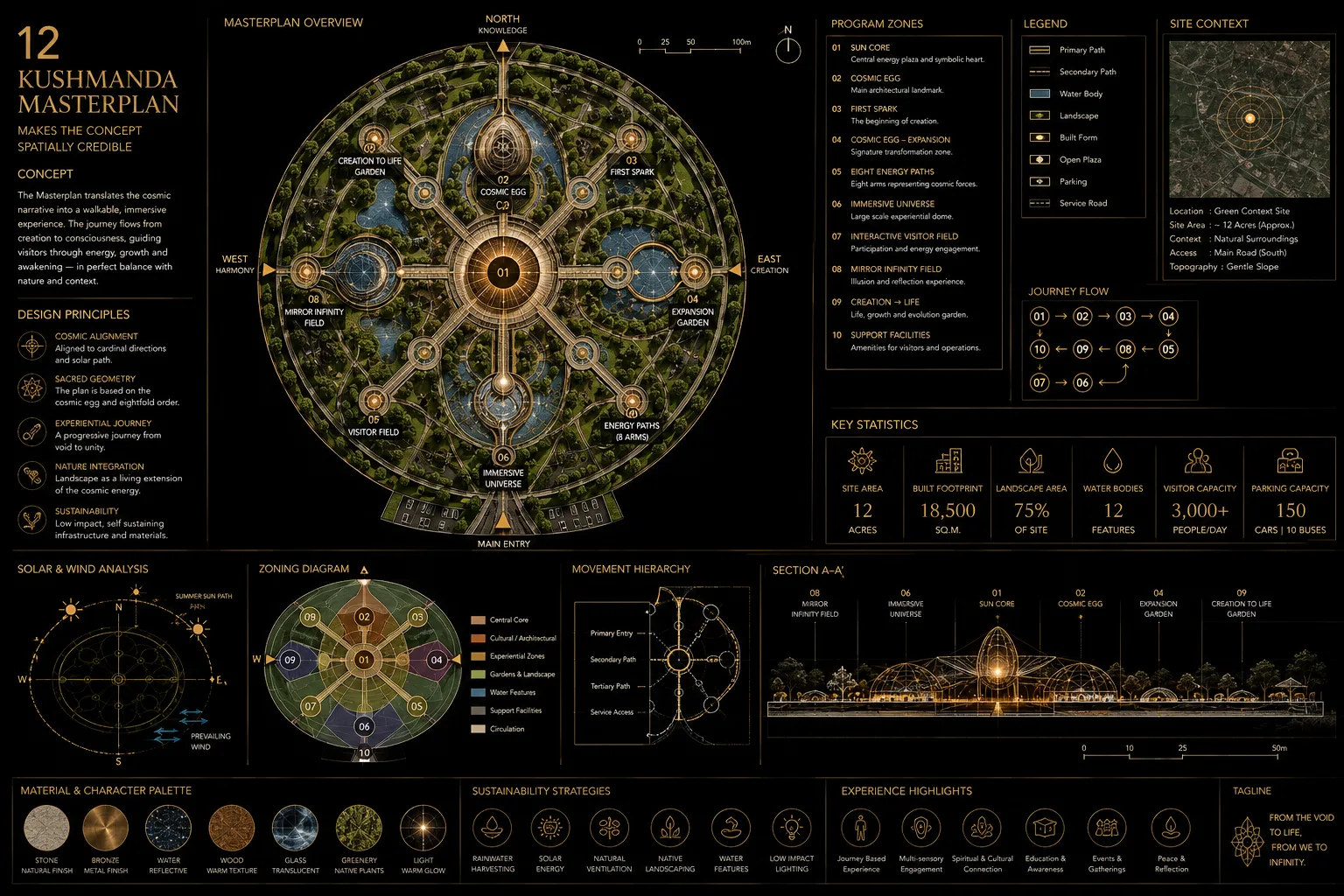
08 — Spatial masterplan: from sequence to site
The masterplan arranges the creative narrative as a sequence of themed spaces around a radial geometry: the central sun core, spark and cosmic egg, expanding pathways, immersive universe, interactive zones, mirror field and creation-to-life garden. Landscaped connections and services are shown as an initial design hypothesis.
The illustrated site area, visitor capacity, dimensions and technical quantities are exploratory placeholders only; none should be treated as surveyed or engineered project data. The next phase of a commissioned design would need site verification, circulation studies, accessibility, emergency exits, integrated media engineering, budgets and a buildable programme.
Why this world follows Chandraghanta
The previous world, Chandraghanta — The Bell of Courage, works through resonance and collective energy. Kushmanda changes the emotional register: a deliberate return to near-nothingness, followed by the gradual emergence of light, life and a universe. Together the Navdurga worlds are treated as chapters in a changing experience of Shakti, not nine repeating decorations.
Explore the full Navdurga Spatial Design Exploration or more conceptual work from Set Craft Atelier.
Design exploration: the visuals are concept renderings and 2D studies, not photographs of an executed installation or verified engineering documents.